Showing posts with label Periodicals postage. Show all posts

Sunday, March 11, 2018

Game Over: Postage Rate Hikes Would Shut Down ESPN Magazine


http://insider.espn.com/insider/espn-the-magazine/

A plan to increase publishers' postage rates drastically over the next five years would cause ESPN The Magazine to cease publication, an ESPN official indicated Friday.

If the Postal Regulatory Commission follows through with its plan "to increase our postage rates 40% over the next 5 years then ESPN will not produce a paper Periodical mailed through the USPS," Dennis Farley, the magazine's distribution director, said in a statement filed with the PRC.

"The content will be delivered via the many other means we now use to deliver our content," Farley added, in emphasizing that ESPN would continue as a popular cable network and web site.

In theory, Farley's statement left open the possibility of using other means to deliver the magazine to its 2 million paying subscribers. But that "other means" doesn't exist for a printed magazine, and digital magazines have mostly failed to catch on with consumers.

The PRC, claiming it has the power to override the inflation-based cap on most postage rates, put forth a plan in December to bail out the U.S. Postal Service with a series of rate increases. The Periodicals class, on which the USPS supposedly loses money, would be hit especially hard.

More than 100 organizations have filed comments with the PRC opposing the plan. Among those was the nation's largest magazine publisher, Meredith Corporation, which recently projected that the rate hikes would force it to stop publishing some titles and reduce the number of magazines it mails by 32%.

Ironically, even under the Postal Service's questionable accounting, ESPN The Magazine is probably a profitable customer for the USPS. The fortnightly is dropshipped entirely on pallets to 175 postal facilities, Farley said, with 83% of the copies in carrier-route bundles.

The Postal Service does well with such efficient mailers while tending to undercharge inefficient Periodicals mailers.


Friday, March 2, 2018

Meredith Warns PRC of Massive Magazine Cutbacks

A plan to jack up postal rates over the next five years would force the nation’s largest magazine publisher to slash its print offerings, according to the company’s CEO.

Meredith Corporation would “pursue magazine closures, circulation cuts, issue frequency reductions, conversions to digital only formats and alternative delivery for some magazine subscription copies,” Tom Harty, the company’s president and Chief Executive Officer, wrote in comments filed Wednesday with the Postal Regulatory Commission.

32% fewer magazines
“We conservatively estimate that the PRC’s proposed rate structure will result in a 32% reduction in the number of periodical pieces mailed by Meredith (a loss of approximately 310 million pieces annually),” Harty wrote. “At this level of volume decline, the Postal Service will receive less revenue, not more, from Meredith than it does under the current CPI [Consumer Price Index] cap system.”

He said the company spent nearly $322 million on postage last year. (He didn’t clarify whether that number included last year’s postage bill for Time Inc., which Meredith purchased a month ago.)

The PRC acknowledges that its package of proposals could raise Periodicals postage rates by more than 40% over the next five years. And that's assuming the inflation rate remains at 2%.

Meredith's corporate headquarters
Meredith is among more than 150 organizations that have submitted comments, mostly unfavorable, about the proposal. A variety of mail-dependent businesses and non-profits are challenging the PRC’s claim that it can enact the rate hikes without Congressional approval.

And the move to bail out the Postal Service with rate hikes is also unnecessary, some have noted. The billions of dollars the agency is supposedly losing every year are a figment of inept government accounting procedures. A recent analysis noted that the USPS closed out Fiscal Year 2017 with “$10.5 billion in cash and cash equivalents, more than it has possessed in the last 15 years.”

Of each dollar Meredith spends on producing and distributing magazines, 40 cents goes to the USPS – up from 24 cents in 2006, Harty said. And that’s “despite ongoing presort and drop ship optimization by Meredith” that should have reduced the costs of delivering those magazines.

Shooting itself in the foot
Harty also pointed out that Postal Service mismanagement has hampered efforts to make Periodicals mail more efficient. The USPS, for example, keeps decreasing the incentive to place copies into carrier-route bundles even though doing so significantly reduces the agency’s mail-handling costs. With better incentives, he said, publishers would do more to reduce the Postal Service’s costs via co-mailing and other measures.

He also noted that the Flats Sequencing System, which was supposed to reduce the Postal Service’s costs of delivering flat mail, has been an abject failure – and is getting worse.

“The total cost processing and delivery cost for an FSS flat exceeded that of a Carrier Route flat by 14.7 cents/piece in FY2015, 16.8 cents/piece in FY2016, and 19.9 cents/piece in FY2017,” Harty said. “The PRC’s proposal . . . will do nothing to incent the Postal Service to fix (or abandon) the FSS debacle.”

Related articles:

Sunday, February 18, 2018

Boondoggle: The FSS Goes from Bad to Worse

The USPS's recently released annual FSS Scorecard

The U.S. Postal Service’s money-losing Flats Sequencing System is becoming even less productive and more problematic, according to the USPS’s own statistics.

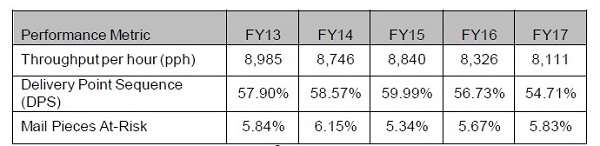
In the past two years, the average number of mail pieces processed per machine hour has decreased by 8%, and the proportion of “mail pieces at risk” (such as copies that are jammed in the machinery) has risen by 8%, according to information the USPS file recently. (See pages 2-4 of this PDF containing responses to Postal Regulatory Commission questions.)

Meanwhile, the proportion of FSS-zone flats that get fully sorted by the football-field-sized machines has declined nearly 10%. That means that nearly half of FSS flats end up being processed on an automated flat sorting machine (AFSM) and/or sorted manually.

The USPS spends 40% more to deliver flat mail that is addressed to FSS zones than to non-FSS zones (which use less automated methods), an expert’s study concluded last year. That indicates that the system wastes several hundred million dollars annually – not counting the initial $1.3 billion purchase price of the 100 machines.

But postal officials have resisted calls to scrap or rethink the FSS. A year ago, the USPS said it is still learning how to optimize the machines, stating that the technology “is in its relative infancy.” But, clearly, this baby is failing to thrive.

Instead of developing a Plan B for flat mail, postal officials and the PRC are pushing for Postal Service bailouts that in essence would force mailers of catalogs, magazines, and other flat mail to cover the FSS’s added costs. Dead Tree Edition has dubbed that the Stupidity Tax -- making mailers pay, in the form of higher postal rates, for the USPS's stupidity and stubbornness in moving forward with its FSS investment despite numerous red flags.

The PRC’s tentative plan, for example, would punish Periodicals and non-carrier-route Standard flats – because the USPS allegedly loses money on them – with five years of required rate hikes that could easily total more than 40%.

Related articles:


Thursday, April 13, 2017

Why the Flats Sequencing System Should Be Scrapped

A 2011 presentation explained how FSS would
streamline the handling of flat mail. Oops!


What many have long suspected has now been confirmed: The U.S. Postal Service’s Flats Sequencing System is a disastrous failure that cannot be fixed.

The FSS is adding so much to the costs of handling magazines, catalogs, and other flat mail that no amount of machinery tweaks, Lean Six Sigma projects, or "Tiger Teams" can ever make it right.

“When all processing and delivery costs are included, an average Periodicals flat addressed to an FSS zone costs over 10.5 cents more than if addressed to a non-FSS zone,” postal expert Halstein Stralberg wrote recently. Assuming the same 40% cost differential applies as well to flat-shaped Standard Mail, such as catalogs and retailer flyers, Stralberg’s analysis indicates that FSS is adding several hundred million dollars annually to the Postal Service’s costs.

And that doesn’t even count the $1.3 billion spent on purchasing the huge machines or the additional investments in building modifications, training, and other start-up costs.

“Because of the large investment in the FSS and the great hopes that were attached to them, USPS managers appear still unwilling to admit that the program is a failure,” wrote Stralberg, a longtime consultant on postal costing and prices to Time Inc.
 
Another utopian vision from 2011
Based partly on Stralberg’s analysis, three mailer organizations recently called for the USPS to “(1) retire the FSS machines, (2) allow mailers of flat-shaped mail to prepare their mail for (and qualify for) Carrier Route and other discounts in all zones; and (3) make Carrier Route and other worksharing discounts for flats deep enough to cover 100 percent of the costs avoided by the worksharing.”

“These reforms alone should encourage enough co-mailing to enable Periodicals Mail and flat-shaped Marketing [aka Standard] Mail to cover all, or nearly all, of their attributable costs,” they told the Postal Regulatory Commission.

The three organizations are MPA-The Association of Magazine Media, the Association for Postal Commerce (aka PostCom), and the Alliance of Nonprofit Mailers.They submitted their comments and Stralberg’s analysis to the PRC to counter the USPS’s proposal to abolish the inflation-based cap on Periodicals postage rates, as explained in my recent Publishing Executive article, Postal Rate Fight Continues as Publishers Battle USPS "Stupidity Tax".

A 2003 Stralberg presentation correctly predicted
FSS mail would cost more than carrier-route flats.
Stralberg’s predictions in 2003 about why FSS would not reduce flats-processing costs have turned out to have nearly prophetic accuracy, except the program turned out even worse than he expected.

For example, he contradicted postal officials who claimed that their costs for FSS-sorted pieces would be lower than for pieces in carrier-route bundles. (Postal officials now acknowledge that carrier-route mail is cheaper to deliver than FSS mail.)

But Stralberg never predicted that the FSS cost per Periodicals piece would be nearly double that of carrier-route pieces, as his recent analysis shows.

Here’s the MPA/PostCom/ANM summary of why the Postal Service’s assumptions about FSS turned out to be so fatally flawed:

1) “The Postal Service’s planners greatly underestimated the extent to which mailers would sort flats to the carrier route level.” About half of flat-mail copies were in efficient carrier-route bundles when FSS was first conceived more than a decade ago. Because of co-mailing and similar mail-consolidation efforts by printers, the proportion is now higher than 70% in non-FSS zones. (When a system nearly doubles the cost of handling 70% of the mail, it cannot possibly save enough on the other 30% to reach breakeven.)

The view from 2010, before reality intruded.
2) “The Postal Service overstated the costs of manual sequencing of carrier route flats by carriers, and thereby overestimated the costs saved by diverting the sequencing work to the FSS.” Stralberg called out this flawed assumption in a 2003 presentation to mailers and postal officials.

3) “The Postal Service, erroneously assuming that practically all flats within an FSS zone would be placed in delivery sequence by the FSS, removed the vertical flats cases carriers had used for manual sequencing.” This triumph of optimism over reality adds to the amount of time carriers need to prepare flat mail for delivery. Barely half of the flats in FSS ZIP codes are presented to carriers in delivery sequence.

4) “The Postal Service’s planners incorrectly assumed that nearly all flats would be machinable on the FSS.” Stralberg warned in 2003 that flat mail unsuited for the Postal Service’s existing machines probably couldn’t be handled on the FSS, meaning that “non-machinable flats will cost more” under FSS.

5) “The Postal Service’s predictions that practical concerns about the FSS machines themselves, including their footprint, cost, and complexity, would be solved during the design and implementation of the system proved incorrect.” That’s nearly a direct quote from Michael Plunkett, a USPS pricing manager when FSS was being developed and now PostCom’s President and CEO. He also told the PRC, “From the outset of the FSS project there was significant skepticism that the proposed technology would achieve the intended results and concern that substantial capital was being invested in a system that would unnecessarily complicate a network that already needed to be rationalized.”

6) “Finally, because flats mail volume was lower than the Postal Service had expected, it added many outlying zones to the territory covered by each FSS machine, causing substantial service degradation.” Mailers warned postal officials more than a decade ago that digital disruption was reducing the volume of printed catalogs and magazines, but the Postal Service persisted with an FSS plan that assumed gradually increasing volumes. Flat mail peaked in 2005 and has dropped about 40% since then.

Related articles:

Sunday, October 16, 2016

New Postal Rates Will Benefit Some Publishers and Printers

Mail that's been sorted by an FSS machhine.
A quiet boycott by some mailers helped persuade the U.S. Postal Service to change how it charges for publications, catalogs, and other flat mail.

As a result, many mailers will pay lower postage bills next year, printers will earn more money from their co-mail programs, and the USPS is likely to benefit as well.

The USPS announced on Wednesday average rate increases of slightly less than 1% for First-Class, Standard, and Periodicals classes, to take effect on January 22. But some customers, including the most efficient mailers of magazines and catalogs, will apparently see their postage bills drop.

The new rate structure will do away with a change first introduced a year and a half ago – separate Standard and Periodicals rates for ZIP codes served by the Flats Sequencing System. FSS rates are higher than rates for non-FSS pieces that are in carrier-route bundles but lower than other non-FSS rates. There was a logic to the separate FSS rates, but they backfired for the USPS.

“Many mailers who previously paid Carrier Route rates for their FSS volume experienced an above average price increase after the new rates were introduced in May of 2015,” the Postal Service said in explaining the new Standard Class rates.

Rate change led to partial boycott
“Since then, FSS volume has declined faster than the volume in other categories of flat-shaped mail” because catalog companies “have significantly curtailed the number of pieces sent to potential new customers (prospecting pieces) in FSS zones. Additional feedback indicates that other flats mailers may be engaging in similar cost mitigation strategies to avoid sending certain pieces in FSS zones.”

Periodicals mailers have little opportunity to engage in similar FSS-avoidance schemes. But publishers, like cataloguers, were talking of legal action a few months ago to prevent the Postal Service from shifting more ZIP codes to FSS, arguing that would in essence be an illegal rate increase.

The new rates would eliminate that controversy. Standard and Periodicals rates will be identical in FSS and non-FSS ZIP codes, so the USPS can move forward with shifting more areas to FSS without pushback from its customers.

The additional volume is exactly what postal officials say the giant FSS machines need to run efficiently. And by restoring some of the incentives to co-mail, the new rate structure should result in flat mail being presented to the USPS in more efficient packages and closer to the point of delivery.

One  failure, one success
Two major investments have been made this century in reducing the costs of handling and delivering flat mail pieces – USPS’s $1.4-billion Flats Sequencing System and the publication-printing industry’s massive expansion of co-mailing.

The FSS so far has failed. But co-mail – consolidating mail from a variety of customers in a way that reduces both the mailers’ and the Postal Service’s costs – has been a huge success.

Such a success, in fact, that it has undercut the ROI of FSS. Thanks to co-mail, more than 70% of flat Standard and Periodicals mail going to non-FSS zones is in carrier-route bundles, up from less than 50% when FSS was first planned. That means much of the Postal Service’s expected savings from FSS have already been achieved via co-mail.

By reducing the incentives to co-mail, the FSS rates actually undercut what the printers achieved. But the January rate structure will restore and actually enhance the incentives to co-mail.

For example, the Periodicals piece rate for copies that are in carrier-route bundles will not change, but the rate for copies in the next-best category will rise by more than 3%. That means the minimum savings from promoting a copy to carrier route will rise from 9.8 cents to 10.7 cents. Printers that use co-mail and other techniques to bring about such shifts typically get a share of their customers’ postal savings.

For publishers that have a high percentage of copies in carrier-route bundles, the savings from eliminating the FSS rates will outweigh the higher rates for less efficient copies – resulting in lower average postal rates.

The picture for Standard flats, such as catalogs, is more complicated. But again it appears that the incentives to improve mail sortation will be greater and that the most efficient mailers will enjoy lower postal bills.

Related articles:

Wednesday, June 15, 2016

Nose of the Camel?: USPS Sneaks in a Rate Hike

Flats Ejection System: "Flyouts" plague FSS.
June 16, 2016 update: At 5 p.m. today, 19 hours after the article below was published, the U.S. Postal Service issued an Industry Alert entitled "Inadvertent Addition of New FSS Zones" as follows:

There were 27 new FSS zones inadvertently added to the July 1, 2016 effective L006 Labeling List as referenced in the Labeling List Changes section of the June 9, 2016 Postal Bulletin (22443). To resolve this action, the newly added zones will be removed from the L006 Labeling List effective August 1, 2016. In addition, mailers may take advantage of the 30-day grace period and opt to continue to use the June 2016 L006 list. Alternately, where the July list has already been implemented, software providers and mail service providers may remove the 27 zones from the list where applicable. The 27 zones to be removed are as follows: 02360, 02738-39, 02769-70, 02878, 02921, 07021, 07027, 07054, 07059, 07069, 07076, 07410, 07435, 07438, 07460, 07480, 23120, 23691, 64050-54, 64056, and 64058. 

Magazine publishers, newspapers, catalogers, and other senders of flat mail are slated to be hit with a backdoor postal rate increase next month.

Implemented without hearings, or regulatory approval, the rate hike will be tiny – a small fraction of 1% for most mailers. But the U.S. Postal Service has given mailers good reason to believe this is just the proverbial nose of the camel in the tent.

So don’t be surprised if there’s a legal challenge to block this precedent, as explained in Good Money After Bad? Mailers Try to Block FSS Expansion.

Officially, what the USPS posted last week in its Postal Bulletin was not a rate hike but rather a “Labeling List Change” – to have its Flats Sequencing System (FSS) machines process mail for an additional 29 ZIP codes. But the shift will mean higher costs for mailers because the postage on Standard, Periodicals, and Package Services flats are typically several cents per piece higher than what is paid for traditionally packaged mail.

No warm and fuzzy
More than 70% of non-FSS mail is presorted into carrier-route bundles, and“FSS is more costly [for the USPS] to process than Carrier Route prepared mail,” postal guru Joe Schick of Quad/Graphics wrote recently in FSS – A Four Letter Word.

“Despite all the discussions around FSS between the mailing industry and the USPS, we have never seen anything that would give us a warm fuzzy feeling about the ability of FSS to be the low-cost process it was intended to be,” Schick wrote.
Was the change "inadvertent"? Vote here.

No one has been able to squeeze a coherent explanation out of the USPS as to why it wants to shift more mail to a less efficient process. But we all know the reason.

It’s the same reason postal officials claim they haven’t bothered to measure the return on the $1.4 billion investment in the giant FSS machines: They don’t want to admit they made a mistake -- moving ahead with the FSS purchase despite the prototype failing two acceptance tests and despite knowing that the entire plan was based on inflated mail-volume projections.

When it comes to the FSS, postal officials are more concerned with CYA than ROI.


Other chapters in the FSS saga include: 

Monday, April 18, 2016

Good Money After Bad? Mailers Try to Block FSS Expansion

An FSS machine: savior or white elephant?
Where the U.S. Postal Service sees an opportunity to expand the Flats Sequencing System to more ZIP codes, mailers see a backdoor rate increase.

Postal officials recently told mailing-industry representatives that declining volumes and some equipment upgrades are creating excess capacity for the FSS. At a meeting of the Mailers Technical Advisory Committee (MTAC), they proposed having the football-field-sized machines process the mail for additional ZIP codes.

See ya in court!
Irate mailers and printers responded by threatening to shift more business to alternate delivery -- private services that bypass the USPS. And they pointed out that the change would in essence be a rate increase for catalogs, publications, and other flat mail. In other words, a legal challenge is possible. (See FSS -- A Four Letter Word for some great insights and additional developments regarding FSS expansion.)

Publication printers are perturbed that they already have to absorb extra costs from handling and shipping FSS mail, without their customers getting any benefit. What’s especially galling is that, no thanks to postal officials, the printers’ expansion of co-mailing is the one recent investment that has brought about significant savings for both flats mailers and the USPS.

Mail that's been sorted by an FSS machine
The catalog and magazine industries are still smarting from a string of broken promises about FSS. They’re in no mood to support an alleged “efficiency” change that appears to be more about saving face than saving money.

Postal officials, including two previous postmaster generals, repeatedly promised mailers that FSS mail would cost no more than traditional carrier-route mail. That made sense: FSS was supposed to save the Postal Service lots of money by automating the labor-intensive process of sorting flat mail into walk sequence.

But it hasn’t worked out that way. On a recent (post-April 10) Standard Class postage statement I examined, FSS-sorted catalogs cost at least 7% more than the equivalent carrier-route pieces.

Today's vocab word: "obfuscatory"
The USPS has given coyly obfuscatory answers to recent questions about its FSS costs, telling the Postal Regulatory Commission a few weeks ago that it had not calculated the return on its $1.4 billion FSS investment. But clearly the system hasn’t worked as planned, and the high FSS postage rates bolster widespread suspicions that the system is still a money loser.

Why then, mailers ask, should the Postal Service throw good money after bad by shifting mail that is mostly in carrier-route bundles to FSS processing? It looks like a lose-lose for both mailers and the Postal Service, except for providing the face-saving illusion that the FSS is working.

Postal officials explain that the FSS would run more efficiently if it didn't have so much excess volume. They told MTAC that the labor-saving high-speed flats feeders they are installing will boost the machines’ throughput by 15% to 20%.

Related articles:


Thursday, March 5, 2015

Sticker Shock: Size of Postal Increase Stuns Publishers

March 6 update: The PRC sent the proposed Standard, Periodicals, and Package Services rates back to the Postal Service for revisions and clarifications. Here's the PRC press release.

Although the April postage hike for Periodicals will supposedly average only 1.4%, some publishers are learning that their increases will be 10 times that amount.

The biggest rate increases will probably hit relatively lightweight publications that contain little or no advertising, such as weekly magazines and association newsletters. Some other publishers, however, will probably see lower postage bills.

Projections for nine leading nonprofit publications show increases ranging from 3.4% to 16.2%, with all but three above 8%, The Alliance of Nonprofit Mailers wrote this week in an alert sent to its members. Although the U.S. Postal Service announced the new rates nearly two months ago, the alliance noted that publishers could not calculate how the rates would affect them until recently, when USPS spelled out some new mailing rules changes that will accompany the new rates.

Such large postage hikes are "likely to force many of these newsletters and magazines to discontinue mailing, or reduce the frequency of their publications, and look elsewhere to achieve their very important mission," the alliance wrote.

"We believe that the Postal Service did not intend to impose such large increases on important nonprofit publications, and that the increases are unintended collateral effects of a larger, complex pricing strategy for Periodicals," the alert said. It added that the alliance is trying to get USPS to amend its rate proposal.

For Periodicals and several other types of mail, the new rates place less emphasis on weight-based charges and more on other factors that have a more direct impact on USPS costs. That's good news for hefty fashion magazines and some types of letter mail, but not so good for mailers that aren't paying much for weight to begin with.

The Postal Service itself has been thrown off by the complexity of its own changes in rates and rules for the Periodicals class. It intended for the average Periodicals increase to be nearly 2%, but has adjusted the calculation to 1.4% after acknowledging calculation errors pointed out by the Postal Regulatory Commission.

And recent questioning from the PRC indicates it may still not be satisfied with the Postal Service's calculations.

Related articles:

Thursday, February 19, 2015

USPS Goof Gives Publishers a Break on Postal Rates

Because of a calculation error, the average postal rate increase for magazines in April will be less than originally announced.

The Postal Regulatory Commission, which spotted the error last week, calculates that the average increase for “Outside-County” Periodicals (primarily magazines, with some newspapers and newsletters) will be only 1.34%, not the originally announced 1.965%. USPS acknowledged the error on Wednesday.

The slip-up came in creating an apples-to-apples comparison of the current rules and rates to the new ones. The PRC noted that the USPS calculations failed to account for new rules that will result in fewer carrier-route bundles and more Flats Sequencing System-optimized bundles.

Given that the Postal Service allegedly loses money on Periodicals Class mail, the PRC questioned why the class’s rate increase was so low -- by far the lowest of the "market-dominant" classes.

“The Postal Service’s intention was to increase Periodicals prices by 1.965 percent,” USPS wrote in its response to PRC questioning. But with the correction noted by the PRC, the proposed rates “unintentionally reflect a percent price increase for Periodicals that is below the goal of 1.965 percent.”

USPS’s response did not indicate it would try adjusting the proposed Periodicals rates, which may not even be possible at this late date. But publishers won’t get off scot-free: In the next round of inflation-based rate increases, the “unused rate authority” is likely to be applied to levying a higher rate hike for Periodicals.

Tuesday, February 3, 2015

Seven Mysteries of the New Postal Rates

It sounds like a small price increase, but the new rates could have large implications for publishers, marketers, printers, and even paper mills.

Nearly three weeks after the U.S. Postal Service proposed hiking most postal rates, mailing experts and regulators can’t figure out what the proposal means.

Agreeing with a coalition of mailers’ groups that USPS’s filing was incomplete for all but First-Class Mail, the Postal Regulatory Commission on Monday extended the discussion period on the proposed April 26 rate increases for “market-dominant” mail classes.

Some mailers are skeptical of USPS’s calculation that the price increases, especially for the Standard and Periodicals classes, are just shy of 2%. But until USPS answers an extensive list of questions about the new rate structures and the new rules that will accompany them, no one can evaluate whether the proposed rate hikes are legal, the PRC said.

A pallet of magazines in FSS-optimized bundles
Even after the rates are fully explained, divining their implications for individual mailers, for USPS, and for others will be no simple matter. Here are seven important but mostly unanswered questions about the rates:

1) How much will my rates change? If you’re assuming the answer is less than 2%, you may be in for a rude awakening. These are is not across-the-board increases. Forever Stamps aren’t going up at all, enabling USPS to stick First-Class business mailers with increases that exceed 2%. The new rules may whack mailers that have mostly carrier-route or high-density mail but result in lower postage for some other mailers. Folio: magazine notes that some rates will double while others will decrease more than 20%; most mailings, however, involve multiple types and levels of rates. Many mailers won’t really know what the new rates will mean until their printer or other service provider can run an elaborate presort analysis, which can’t happen until the new rules and rates are clarified.

2) Will the rates alter how paper is priced and sold in the United States? The new rates would continue and extend the Postal Service’s efforts to de-emphasize weight in calculating rates. USPS acknowledges that it overcharges for weight, in the past using it as a proxy for some of its costs that are not directly weight related. The result is that paper mills tend to charge higher premiums for lightweight paper in the U.S. than they do in other markets, knowing that American postal rates give buyers a strong incentive to use lighter paper. (That’s especially true for magazine-quality papers, which in many other countries are used primarily for products distributed through stores rather than the mail.) But with Standard letters no longer having “pound” rates and with weight charges for some other mail declining, some mailers may switch to heavier paper.

3) For flats mailers, will the new mail-preparation standards be must-do, ought-to-do, or nice-to-do? This is an especially big question for flats mailers, and their printers, because of new preparation standards for mail going to ZIP codes served by the Flats Sequencing System (FSS) and new incentives to create pallets of carrier-route bundles in non-FSS areas. It’s still not clear what mailers will actually be required to do on April 26 and what will be optional but important – for example, valuable enough to overhaul how mail is prepared and shipped. And sometimes USPS incentives are duds, not worth the additional expenses or investment required to take advantage of them.

4) Will the rates and regulations create new competitive advantages for some printers – and disadvantages for others? For many types of printing, a major differentiator is the ability to minimize customers’ mail costs through mail consolidation, in-line customization, dropshipping, etc. Postal officials talk a good game about wanting to encourage co-mailing, selective binding, and other forms of mail consolidation, but that isn’t always reflected in new rates. Conversely, incentives to consolidate and dropship mail can hurt small printing plants that don’t prepare enough mail to obtain the best rates for their clients.

5) Will printers, other service providers, and USPS itself be ready for April 26? The proposed rate structure will have some new charges and apparently lots of new rules and incentives. But software providers can’t redo their coding or printers their mail-preparation procedures or equipment until they know what the new rules will be. And then there’s the question of whether the Postal Service will be ready for the resulting changes in how mail is prepared and delivered.

6) Will the new rules and rates finally make FSS start paying off? USPS’s multibillion-dollar investment in the huge machines was supposed to reduce dramatically its costs of carrying flat mail. But so far, higher handling costs have eaten up the resulting delivery savings, which has increased pressure on USPS to jack up rates for Standard and Periodicals flats. New FSS preparation standards are supposed to address that by changing how mail is packaged for ZIP codes served by the FSS machines, such as by eliminating carrier-route bundles.

7) Will the new rules cause more lightweight pallets and other “tail of the mail” problems? Printers and mailers note that recent changes in postal regulations have forced a lot of flat mail to be placed on extremely light pallets, which tend to cause such problems as reducing the amount of mail that fits into a truck. The new rates include incentives (or requirements; it's not clear yet what's optional) for creating 5-digit carrier-route pallets and FSS scheme pallets. But will that have the perverse effect of causing other mail to be packaged and shipped less efficiently?

Related articles:


Thursday, January 15, 2015

USPS Raising Rates, Imposing New FSS Rules, and Perhaps Inviting a Legal Challenge

Just in the nick of time, the U.S. Postal Service filed price increases averaging nearly 2% late Thursday on most mail except Forever Stamps.

The Postal Regulatory Commission marked receipt of the filing as 4:07 p.m., less than an hour before closing. If USPS had waited until Friday morning, the December 2014 Consumer Price Index would have been factored into the calculation of the inflation-based cap on postage increases -- perhaps lowering the cap because of plummeting gasoline prices that are leading to deflation.
No change for the Caped Crusader

The rate increases on the "market-dominant" mail classes, slated to take effect April 26, range from 1.886% for Standard to 1.965% for the Postal Service's favorite whipping boy, Periodicals. Take those numbers with a grain of salt.

Those are average increases, but I've never met an average mailer. Different types of mail in the same class may experience rate hikes that deviate significantly from the average -- especially for First-Class Mail.

To achieve the average First-Class rate hike of 1.949% without changing the 49-cent charge for a Forever Stamp, other types of First-Class mail will get larger increases, such as 2.417% for presorted letters and postcards and 10.18% for parcels. Within the Standard Class, carrier-route and letter mail will get relatively low increases, but Every Door Direct Mail will rise nearly 5% and parcels nearly 10%.

Mailers of catalogs, magazines and other flat mail in the Standard and Periodicals classes will also face new rules and incentives for preparing Flats Sequencing System (FSS) mail. The impact is likely to vary significantly from customer to customer.

Flats mailers will face "required FSS preparation for all flat-shaped mail pieces destinating in FSS zones" but also "pricing incentives to reward mailers that prepare and enter flats that are most advantageous to the Postal Service."

Generally speaking, CPI-based rate increases take effect as long as the PRC determines that the Postal Service stayed within the rate cap and followed certain other rules. But there could be a different twist this time around.

A Flats Sequencing System machine
Only the Postal Service's Board of Governors can file for a rate change, but Congress has failed to fill so many positions on the board that it no longer has a quorum. Until more governors are approved, a Temporary Emergency Committee of the remaining governors is acting in place of the board.

A legal challenge to the emergency committee's authority to raise rates might delay implementation, if not block them altogether.

It would be a sweet irony if the inaction of Congress -- where a majority of members seem OK with jacking up the postage paid by business mailers -- blocked USPS from rate increases that would fall disproportionately on business and institutional mailers.

Market-dominant rates are slated to decline by 4.3% this summer when the exigent surcharge expires, but that could be altered by an appeals court or an act of Congress. Postal officials seem especially concerned with the consumer confusion that would result if the price of Forever Stamps were increased and then decreased during the same year, which is probably why they left the price alone.

When (or, rather, if) the surcharge expires, it's not clear whether other First-Class rates could again be rejiggered in a way that again enabled the price of Forever Stamps to remain at 49 cents.

For further reading:
 

Monday, November 24, 2014

Postal Service Starts Fiscal Year With a Bang

Maybe it was the election. Maybe it was the economy. Maybe it was even a sign that an organization that was left for dead is bouncing back.

Whatever the reason, the U.S. Postal Service revealed today it had a bang-up October, with domestic mail volume up nearly 7% over the same month last year, rather than the 2% decrease USPS was expecting.

The beleaguered agency had "controllable operating income" of $647 million in the first month of Fiscal Year 2015, more than double what it budgeted or what it earned last October. Controllable operating income excludes what is euphemistically referred to as prepaid retiree health benefits, which USPS has stopped paying, and accounting adjustments for the future cost of workers compensation cases.

Big growth areas
Major mail categories with significant revenue increases over October 2013 included "Permit Imprint Nonprofit Standard" (43%), Parcel Select (30%), "Permit Imprint Regular Standard" (14%), and "Permit Imprint First-Class (7%), according to an in-depth financial report also released today. Even the Periodicals class was up a bit.

In the first month with aggressive parcel rates for large business mailers, volume for Shipping & Package Services rose 14% and revenue by 12%.

Despite the higher volumes, work hours increased by less than 2% and total expenses by less than 3%.

It will take more than one strong month, however, to get one of the country's largest employers out of the financial woods. USPS is frequently on the verge of running out of cash, and it has no ability to borrow money, even for such mission-critical needs as replacing its decrepit, inefficient delivery vehicles.

Related articles:

Monday, September 22, 2014

Postal Rates in 2015 Could Rise or Fall -- or Do Both

The outlook for changes in postal rates for the next 12 months is murkier than it's been in years.

A rate hike, a decrease, an extension of the temporary “exigent” increase, and even an increase and decrease a few months apart are all plausible 2015 scenarios for First Class, Standard, and Periodicals mailers. That uncertainty is a far cry from the past few years, when "market-dominant" postal rates inched up each January based on the rate of inflation.

The 4.3% exigent increase that was implemented in January is the source of the unusual uncertainty. That surcharge is supposed to disappear after it yields the U.S. Postal Service an additional $3.2 billion, presumably in mid-2015.

The three-judge panel considering an appeal of the exigency case seems unlikely either to eliminate the rate hike or to make it permanent, according to Stephen Kearney, executive director of the Alliance for Nonprofit Mailers. But based on the judges’ comments and questions during recent oral arguments, his reading of the tea leaves foresees a decent chance the judges will remand the case to the Postal Regulatory Commission with orders to revise it.

Big risk to mailers
“The big risk to mailers in the remand outcome would be a possible determination by the PRC that the exigent rates would need to raise more than the $3.2 billion in their original order,” Kearney wrote in a summary of the oral arguments. That could result in hiking the surcharge or in extending it.

The main issue in the case is how much revenue USPS lost as a result of the recent recession, as opposed to revenue it would have lost anyway from increased usage of email, online billing, and other digital media.

“The judges seemed to agree that the PRC was right to accept the recession as an extraordinary event under the statute as well as the need for a special rate increase to cover the recession-caused losses,” Kearney said.

However, the judges indicated that the PRC’s decision was unclear regarding how the Postal Service’s recession-related losses were calculated, Kearney wrote. And they questioned whether the PRC’s methodology fell short of counting all the losses.

Two choices
"The judges likely will decide between two choices: to defer to the expert regulating agency and let the PRC order stand, or to remand the case back to the PRC and tell them to do a better job determining and implementing methods to quantify the revenue that the USPS lost as a result of the 2007-2009 recession.”

With the judges taking one to three months to issue their order and the PRC possibly needing additional time to reconsider the case, it could be well into next year before we know the outcome. And even an order upholding the PRC decision would not completely clear up what will happen to postal rates next year.

Mailers and postal officials are still arguing over how to decide when the $3.2 billion target has been reached. One issue, for example, is whether to count the surcharge on all Forever Stamps sold during the exigency period or only on those that are actually used.

USPS officials could implement the usual inflation-based price increase – probably in the 1%-2% range -- in January. But that could mean a 4.3% decrease a few months later if the exigent surcharge expires as currently planned.

Postal officials have indicated they might postpone a January rate increase in hopes of building up enough rate-increase authority to keep rates level when the surcharge expires. However, if the PRC order is upheld and inflation continues at a tortoise’s pace, USPS's rate authority would probably fall a couple of percentage points short, leading to price decreases.

But remember that, in Washington, “temporary” measures to increase government revenue have a way of becoming permanent. For mailers, there’s a danger that Congress will let the Postal Service keep the extra surcharge in place to keep the agency solvent, to preserve Saturday delivery, to stop some postal facilities from closing, or to finance new delivery vehicles.

Or just because.

Related articles:

Tuesday, June 3, 2014

USPS May Delay Next Price Increase

The U.S. Postal Service is thinking about forgoing its usual January price increase next year.

It’s not that postal officials have suddenly been afflicted with a case of generosity after jacking up most postal rates by more than 5% earlier this year. They’re merely preparing for what happens when (or, rather, if) the temporary 4.3% “exigent” portion of the recent rate increase expires.

USPS has gone to court in hopes of making the exigent increase permanent. But if that effort fails, the surcharge will expire after bringing additional postal revenue of $3.2 billion, which will take an estimated 18 months. Postal officials apparently want to avoid across-the-board rate cuts when the exigent increase expires.

“The Postal Service could delay the next rate adjustment so as to coincide with the rescission of the exigent surcharge,” USPS noted in a filing yesterday with the Postal Regulatory Commission.

“If the available percentage of rate authority attributable to inflation were 4.3 percent or greater, then the surcharge could simply be absorbed as part of the scheduled rate change." In other words, USPS could remove the exigent rate increase without actually changing the rates, by simultaneously imposing a normal (inflation-capped) rate increase.

At current inflation rates, the Postal Service’s authority to implement a normal rate increase would be capped not much above 2% when the exigent increase is slated to expire in mid-2015.

“Even if inflation were less than 4.3 percent, the Postal Service could . . . fold in the exigent surcharge into the basic rate structure of some products, while adjusting the prices of other products so as to come out at the cap.” In other words, some products could see no change in rates while others would get a decrease.

USPS’s Board of Governors could pursue other scenarios as well, the filing noted.

“The Governors of the Postal Service could decide to proceed with a January price adjustment for one class of mail — say, Periodicals — while delaying it for other classes.” USPS has been eager to impose additional price increases on magazines and newspapers because it claims to be losing money on the Periodicals class. Apparently, the recent unprecedented quarterly decrease of 8% in Periodicals volume wasn’t big enough for postal officials.

Related articles:

Saturday, May 3, 2014

R.R. Donnelley Ready To Deliver When the Postal Service Doesn't

If Congress decides to allow private delivery of newspapers and magazines on Sundays, the nation’s largest printing company is ready to step in.

“We are looking at alternative delivery methods for content, for physical content,” Thomas J. Quinlan, CEO of R.R. Donnelley, told financial analysts this week. (SeekingAlpha has the complete transcript.) “With the platform that we've built . . . with the addition of [recently acquired competitor] Consolidated Graphics, we've got the ability to be in the majority of populated cities in the United States.”

Thomas J. Quinlan
Quinlan expressed interest in the recent proposal by influential Congressman Darrell Issa, R-CA, that would “permit periodicals, newspapers and unstamped mail to be placed in mailboxes on days when the Postal Service does not provide mail delivery.” Current law gives the U.S. Postal Service a monopoly on delivery to mailboxes.

Issa’s proposal, especially if coupled with curtailment of Saturday USPS delivery, “creates an opportunity for us,” Quinlan declared.

He indicated that Donnelley’s interest is as much about keeping its publishing customers in business (and perhaps gaining a competitive advantage over other printers) as it is about actually making money on the delivery service.

“It's all about our customers and how can we reduce their overall total cost, make them more efficient,” he said. The Postal Service’s recent price hikes and reductions in service are forcing Donnelley to think that way.

Just not sustainable
“Look what USPS is doing to the mailing industry. It's just not sustainable. There's significant cost increases that they've put through. They're shifting cost to the players in the mailing industry, Quinlan said. “All these things, these are costs for the mailing industry that, quite frankly, we and other people like us have to go ahead and mitigate to our customers because our customers can't go ahead and aren't going to take the additional cost and look for people like us to, again, go ahead and mitigate those.”

“You look at Ladies' Home Journal that was announced by Meredith earlier this week [would be shutting down]. I mean, 40 to 47 percent of their cost was related to postage. It was nothing to do with electronic content.”

Issa’s proposal is no slam dunk. It’s sure to face a full-court press from postal unions and front-line employees who fear it would cost jobs and undercut the Postal Service.

USPS's position on the proposal is not as clear. The agency doesn’t want to give up the mailbox monopoly. But if it really loses money on delivering periodicals, as it claims, then perhaps it would welcome the opportunity to lose some of that business to the private sector [though methinks the alternate-delivery services would cherry-pick the most efficient periodicals mail and leave the dregs to USPS].

For a few years during the early 1990s, two alternate delivery networks that used newspaper publishers to deliver monthly magazines to driveways and front doors grew rapidly. But USPS won the magazines back – and squashed the private services -- by introducing more rate incentives for efficient Periodicals class mailers.

Related articles:
 

Tuesday, April 1, 2014

Postal Service Dragging Its Feet on Fixing Periodicals

Postal officials, who frequently complain about losing money on Periodicals mail, bear much of the blame for that loss, according to the Postal Regulatory Commission.

“The Commission is increasingly concerned that the Postal Service’s Periodicals pricing strategy is leading to inefficient mailer preparation,” the commission wrote recently in its review of 2013 postal rates, echoing a complaint that magazines have been making for the past decade.

“The inefficient pricing signals being sent by the Postal Service’s prices prevent the Postal Service from maximizing contribution from Periodicals. Further, the inefficient price signals are increasingly creating winners and losers within the Periodicals class.”

The Postal Service’s flawed accounting shows that it receives only 76 cents in Periodicals-class revenue for every dollar it spends delivering magazines and newspapers. That was an improvement of 4 cents over the previous year – the first improvement since 2008 – but it hasn’t eliminated the political and legal pressure to jack up Periodicals rates.

A year ago, in considering whether Periodicals rates are legal, the PRC directed USPS to “leverage its pricing flexibility to improve Periodicals bundle and container pricing to incent more efficient mailer preparation and increase contribution from Periodicals.”

The efficient subsidize the inefficient

Instead, the commission chided, USPS has followed its same old approach to Periodicals pricing – just raising rates by the same percentage across the board. As a result, efficient Periodicals mailers are subsidizing inefficient ones, and USPS is losing out on a change to get publications to mail in ways that reduce its costs.

For example, the PRC wrote, the Postal Service’s own study shows that copies in carrier-route bundles are among the most profitable type of Periodicals mail, yet USPS steadfastly refuses to improve the incentives for carrier-route bundles. [In fact, it’s actually watered down the incentive over the years.]

The PRC noted that the Postal Service has undertaken various initiatives to reduce the cost of Periodicals and other flat mail, but “the Commission is concerned that the Postal Service is not measuring the success of the operational initiatives it has implemented to reduce the costs of Flats.”

It cited a statement from two trade associations urging the PRC “to ‘confront directly the elephant in the living room of Periodicals mail pricing: the Postal Service’s failure to rein in the out-of-control costs of Periodicals Mail despite large investments in automation equipment by the Postal Service, and large increases in worksharing by periodical publishers and their mail service providers.’”

No explanation

Postal officials never have offered a plausible explanation for the USPS's allegedly escalating costs for handling Periodicals.

If the saying that “what gets measured gets done” is true, the Postal Service is shooting itself in the foot by not tracking which of its cost-cutting efforts are working. How can it decide which ones need to be tweaked or scrapped and which ones are worthy of expanding and emulating?

Are postal officials more interested in avoiding the embarrassment that comes with owning up to failures than they are in improving their operations?
  
Related articles:

Saturday, February 22, 2014

Postal Officials Don't Know Whether the FSS Is Saving Money

The U.S. Postal Service doesn’t know whether the Flats Sequencing System is reducing its costs and doesn’t seem to be trying to find out.

As a result, one major mailer is calling for hefty price increases on “Standard flats” (such as catalogs) that would presumably spill over to the Periodicals class (magazines and newspapers) as well.

Both postal officials and mailers have been hoping for several years that FSS would yield substantial decreases in the cost of handling and delivering flat mail. But only about 30% of flat mail is being processed on the football-field-sized machines, which are failing to live up to expectations and have led to a legal dispute between USPS and the company that built the machines.

“Based on available information it appears that [increased use of FSS] either lowered costs or left them unchanged,” the Postal Service recently told the Postal Regulatory Commission. But that conclusion, USPS acknowledged, was “determined in a simplistic fashion” based on comparing total flats-handling costs in FY2013 to those in FY2010, when it began installing the $1.3-billion FSS.

USPS told the PRC it has not done a head-to-head comparison of the cost of sorting and delivering FSS mail versus the primary alternative method, the older and less sophisticated AFSM 100 machines.

A year ago, the Postal Service said FSS had apparently increased the costs of handling flat mail because low machine productivity ate up the savings from automating some delivery functions. But it noted at the time that it was investing in productivity improvements to the machines.

FSS productivity, however, declined by 2% during FY2013, according to a recent USPS filing with the PRC.

USPS’s responses demonstrate “there is no reason to expect a meaningful reduction in the unit cost of handling flats as a result of deploying all 100 FSS machines,” Valpak told the PRC this week. “Accordingly, the only way for Standard Flats to achieve breakeven and become profitable is via significant rate increases, imposed without delay.”

Valpak, which uses Standard letter mail to send coupons and advertisements for multiple clients, is a frequent critic of Standard flats postal rates that allegedly subsidize Valpak’s competition. Valpak’s logic for advocating price hikes for Standard flats would apply as well to Periodicals flats; the Postal Service says it loses money on both types of mail.

A big wild card in the debate is whether a recent change in postal regulations will boost FSS productivity. Starting late last month, presorted flat mail going to FSS ZIP codes must be packaged in a manner that is optimal for the FSS operation. In theory, the change will decrease mail-handling costs without affecting delivery operations.

But that still leaves us with a troubling question: If USPS doesn’t really know how FSS is affecting its costs, how will it know whether to continue investing in and running the machines? Postal officials have typically brushed off such questions, responding that they have no choice but to automate the labor-intensive process of sorting flat mail.

Without good cost analysis, however, how will postal officials know whether all the “tiger teams” and machinery tweaks and changes in regulations are paying off? And how will they know whether to continue running the machines or to consign them to The Museum of Good Intentions Gone Bad?

Related articles:
 

Tuesday, May 28, 2013

FSS Postage Pricing Will Affect Magazines, Catalogs, and Printers

The U.S. Postal Service’s growing confidence in the troubled Flats Sequencing System may lead to an overhaul of postal rates and significant changes at printing plants in January.

Postal officials have said recently that they plan to implement new postage rates for the Standard and Periodicals classes (and perhaps First-Class Mail) early next year that include “an FSS pricing structure.” Details have not been released, but discussions indicate the plan will include significant incentives for mailers to create FSS-optimized bundles for ZIP codes served by the giant machines while continuing to make traditional carrier-route and 5-digit bundles for non-FSS areas.

A Flats Sequencing System machine
The move would take aim at a major reason the $1 billion-plus FSS investment so far has increased USPS’s mail-handling costs more than it has reduced delivery expenses: The vast majority of flat mail is still prepared in the traditional manner, which creates extra preparation work at FSS facilities.

Most Standard and Periodicals class flat mail is currently placed in carrier-route bundles, with each bundle containing pieces destined for the same carrier route. A Periodicals carrier-route bundle may have as few as six magazines or newspapers and be only a fraction of an inch thick.

An FSS-optimized bundle, by contrast, is at least four inches thick and contains pieces from multiple carrier routes and often from multiple ZIP codes. That will mean far less handling prior to loading mail into the FSS, but also introduces a new risk: FSS machines have no “Plan B”.

Working traditional bundles on an FSS machine is somewhat inefficient but still works. The converse is not true, however. If the machines break down or are otherwise over capacity, there is no easy way to shift FSS-optimized bundles and pallets to traditional processing.

In recent meetings, such the Mailers Technical Advisory Committee (MTAC), postal officials have described the extensive work they have put in to making the FSS machines more reliable and predictable – such as studying and standardizing best operating practices, tweaking the equipment, and implementing more aggressive preventive maintenance.

Making larger bundles should increase bindery and co-mail efficiency for printers. But now they will also have to follow two very different sets of rules for bundling and containerizing flat mail – a new rule set for FSS ZIP codes and the current rules for non-FSS zones.

The FSS rules and pricing may end up being optional next year, but the incentives are likely to be high enough that commercial printers will not be competitive for producing catalogs, magazines, and circulars unless they can follow the FSS rules.

Related articles:

Saturday, April 20, 2013

New Postal Incentive Could Backfire for Mailers

Mailers should beware of postal officials bearing gifts.

The U.S. Postal Service announced a few days ago a “Technology Credit” of up to $5,000 for mailers who use Full-Service Intelligent Mail Barcodes. But if the Postal Service gets its way, the one-time credit would result in a permanent and ultimately far more expensive price increase for senders of First Class, Standard, Periodicals, and Bound Printed Matter mail.

And it would set a precedent for similar efforts to circumvent the inflation-based price cap on most postal rates.

“The purpose of the Technology Credit is to offset a portion of the investment by mailers in the hardware and software changes necessary to support Full-Service mailings,” the USPS filing said. Mailers already have another incentive to go Full Service by Jan. 26, 2014: After that, only mail with Full Service IMbs will receive automation discounts.

At an estimated cost of $66 million, USPS will provide credits to mailers that have mailings containing at least 90% Full-Service pieces between June 1, 2013 and May 31, 2014.

Here’s the catch: USPS is asking the Postal Regulatory Commission to consider the credits a price decrease for purposes of calculating the price cap for the next round of rate changes. Without such consideration, USPS claims it would be discouraged from offering future credits that promote more efficient mailing practices.

The logic of the request seems to be that the Postal Service would be paying out credits of $66 million to mailers in the coming months, so it should be able to balance that with $66 million worth of price increases next year.

But consider the case of a major magazine that now pays $10 million annually in Periodicals postage and earns the $5,000 Technology Credit. If the Consumer Price Index doesn’t change during the course of 2013, the magazine normally would not face a postage increase next year.

With the Postal Service’s request, however, even with no inflation the Periodicals rate cap would increase an estimated one-quarter of a percent. That increase would cost the magazine almost $25,000.

And if the inflation rate remained zero percent for another year, again the magazine’s postage bill would be $10,025,000 – instead of the even $10 million it would be if the USPS's request is denied

In other words, if the Postal Service is successful, the magazine would get a $5,000 credit this year and in return pay a recurring charge of almost $25,000 annually. With a return on investment like that, no doubt postal officials would look for other one-time credits they could “give” mailers.

The PRC has set a deadline of May 6 for comments on the Postal Service’s proposal.

Other articles about postal price-cap controversies include: