Showing posts with label Amazon. Show all posts

Monday, May 13, 2019

Study Refutes Trump's Claim That USPS Loses Money on Amazon

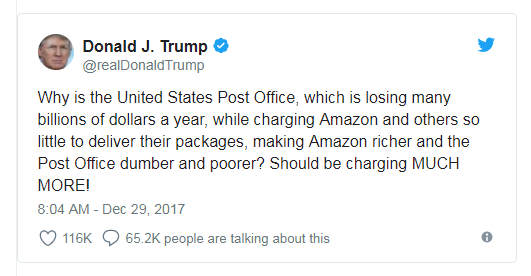
An independent government watchdog today seemingly refuted President Trump’s claims that the U.S. Postal Service loses “a fortune” on a sweetheart deal with Amazon.

The USPS Office of Inspector General released a study indicating that the Postal Service’s growing practice of entering into customized contracts with package shippers is paying off.

“The number of these 'Negotiated Service Agreements' (NSAs) has increased from 66 in fiscal year (FY) 2012 to more than 1,000 in FY 2018,” the report says. “In FY 2017, only five contracts lost money, down from 14 the previous year.”

“The Postal Service’s largest NSAs contribute the most financially.” The few money-losing contracts have been “mostly low-volume NSAs,” the report says, and the USPS and Postal Regulatory Commission typically take action to fix or terminate those deals.

NSAs are “solidly profitable” and “perform strongly for the Postal Service,” the Inspector General’s report states. The watchdog agency has often criticized the Postal Service severely on other matters.

The report was heavily redacted – enough to put even Attorney General William Barr to shame – to avoid any public mention of specific customers or any revelations that would help the USPS’s private-sector competitors.

But it clearly suggests that the Postal Service is making a profit on such major “Parcel Select” customers as Amazon, FedEx, and UPS.

Though there are only 24 Parcel Select NSAs, the report indicates that they have as much volume and generate more revenue and profit than any of the other four types of domestic-shipping NSAs.

“Parcel Select is generally used by consolidators and large shippers who can presort packages and drop them off by the truckload at postal facilities that are close to the final destination, paying a lower rate based on how close they get the packages to their delivery point. The Postal Service takes the packages the ‘last mile’ and delivers them to their ultimate destination,” the report explains.

In other words, because these shippers handle everything except for the last mile, they are profitable for the Postal Service even though they pay less than does someone who drops off packages at her local post office for delivery in another state.

Parts of the report were heavily redacted.
“NSAs are a tool to better meet customer needs when some aspect of the Postal Service’s off-the-shelf offerings does not,” the report says. Private-sector competitors have similar practices:

“Most carriers offer discounts to certain classes of clients, such as new customers or high-volume shippers. As a result, carriers can charge very different prices for delivering the same package to the same destination.”

“Many NSAs bring in new customers that were previously shipping with another carrier,” the report says. “So long as those deals cover their costs, any product-level profits they generate would improve the Postal Service’s bottom line because the profit is based on new volume.”

But when a customer already does most of its shipping with the Postal Service, an NSA may reduce prices in a way that makes the customer less profitable, the report notes.

The report doesn't address whether the Postal Service's cost-accounting practices are keeping pace with the rapid growth in package delivery or are accurately measuring the cost of such deliveries.

Related articles:

Monday, January 1, 2018

Trump Is Wrong, Mostly, About Amazon and USPS

Low rates don't mean unfair rates. But do Amazon deliveries create hidden costs for the USPS?

President Trump was off base Friday when he implied that Amazon has a sweetheart deal with the U.S. Postal Service.

But for reasons unrelated to Trump's' charges, it may be time for the USPS to rethink the prices it charges Amazon and perhaps for all package deliveries. In fact, there’s evidence the Postal Service is already doing that.

While containing no outright falsehoods, Trump’s tweet is a mix of truth and debatable claims.

Let’s take apart his claims:

• The USPS is “losing many billions of dollars a year”: Officially, that’s true, but only because the Postal Service is indirectly subsidizing the federal government via prepaid retiree health benefits and by paying more than its share of combined federal/USPS pension costs. Absent those accounting gimmicks, the Postal Service has operated at about breakeven the past few years.

• The USPS “is charging Amazon and others so little to deliver their packages”: True, but it's a non-issue. The USPS is generally able to charges the lowest rates for residential parcel deliveries it's the low-cost provider.

• “Making Amazon richer”: The Postal Service’s moves to gain a larger share of the residential package market have definitely benefited Amazon – and plenty of others who ship packages. Competition tends to do that. It's called capitalism.

• The Amazon deal is making the USPS “dumber.” Not likely. The USPS can learn from Amazon’s sophisticated approach to logistics.

• The Amazon deal is making the USPS “poorer.” Not according to the Postal Regulatory Commission, which vets package-delivery rates, including those negotiated privately by the likes of Amazon, to ensure they are profitable for the Postal Service.

Trump isn’t the first to question the low postage rates Amazon pays. Various commentators, special-interest groups, and others have raised the issue from time to time.

Challenges to the Amazon deal fall into three categories: the “sweetheart deal” argument, the “unfair competition” argument, and our own Dead Tree Edition observations.

The “sweetheart deal” argument
Those who claim Amazon negotiated too sweet a deal with the Postal Service naively point to estimates that its postage rates are well below those paid by mom-and-pop shippers. A Wall Street Journal op-ed written by the head of “a money-management firm that owns FedEx common stock” (Hmm, any bias there?) typifies the muddled thinking:

“The U.S. Postal Service delivers the company’s boxes well below its own costs,” wrote Josh Sandbulte, who estimated that the USPS handles about two-thirds of Amazon’s U.S. deliveries. “Select high-volume shippers are able to drop off presorted packages at the local Postal Service depot for “last mile” delivery at cut-rate prices. With high volumes and warehouses near the local depots, Amazon enjoys low rates unavailable to its competitors.”

In other words, Amazon goes to great expense to minimize the USPS’s costs of delivering Amazon packages; in return, Amazon pays lower postage rates. Such “worksharing” discounts are a standard, and quite logical, part of most postage rates: The more you do to reduce the Postal Service’s costs – via sorting, dropshipping, efficient packaging, etc. – the lower your postage bill.

Amazon presented the chart below to the PRC early this year in defense of its low rates, saying it “has established a transportation and distribution network of more than 25 sort centers and more than 70 fulfillment center warehouses. This network enables Amazon to inject parcels at Postal Service Destination Delivery Units (“DDUs”) already presorted for delivery to the customer.”


“This arrangement," Amazon says, benefits the Postal Service by letting it make more efficient use of its delivery facilities, equipment and personnel while avoiding the costs of building additional capacity in the Postal Service’s upstream network.”

The “unfair competition” argument

FedEx itself, along with fellow USPS competitor United Parcel Service, has a more sophisticated argument – that parcel shippers aren’t paying their fair share of the Postal Service’s costs.

Imagine that a letter carrier delivers four pieces of mail and one Amazon package to a particular address. The “fair-share” camp says that at least 20% of the labor, fuel, and other costs required to make that delivery should be assigned to the package.

But the USPS only looks at the incremental costs of delivering packages and other “competitive” products. For example, the labor and fuel required to drive to the mailbox are not factored into the cost of (or price for) delivering the package because those costs would exist even if the carrier were only delivering the letters.

The result, say USPS’s competitors, is that the Postal Service undercharges package shippers while overcharging those who send letters and other traditional mail. But the PRC sides with the USPS.

Dead Tree Edition's observations
The USPS-PRC approach to pricing isn’t just consistent with the law, it's good business practice.When evaluating a product, the question is whether the organization would be more profitable without the product than with it. That means ignoring any costs that would remain if the product were discontinued.

But the USPS-PRC approach has a couple of shortcomings.

Because its tiny 30-year-old delivery vehicles were designed primarily with letters in mind, the Postal Service is increasingly relying on parcels-only delivery routes to cope with the e-commerce boom. That’s driving up the average cost of delivering a parcel.

But setting postal rates is a bit like driving while looking in a rear-view mirror: Projections are based on elaborate analyses of historical data – in this case of a time when most parcel deliveries could easily be piggybacked onto regular mail routes. It’s also unlikely that the Postal Service’s current cost models fully reflect the increasing amount of real estate devoted to sorting and handling parcels.

And it’s well-nigh impossible for those models to factor in opportunity costs.

The USPS’s deals with Amazon have been based on the premise that most of the additional deliveries would be done by city carrier assistants (CCAs), whose compensation is less than half that of career letter carriers. The labor contract with the National Association of Letter Carriers caps the number of CCAs the USPS can hire, while allowing additional ones to be brought on for non-traditional ventures like the Amazon deals.

But, contrary to its expectations, the Postal Service has struggled to hire, train, and retain the full complement of CCAs. The parcel boom has also meant plenty of work – and overtime -- for CCAs and career carriers alike.

Under these conditions, the Amazon deal is sucking up a limited resource: inexpensive (about $17/hour) CCA labor. That deprives the Postal Service of the cost-reducing opportunity to use more straight-time CCA hours on non-Amazon deliveries.

Here’s a hint that the Postal Service may be wising up to such hidden costs: A small experimental venture that had CCAs delivering groceries for Amazon Fresh apparently collapsed recently. One reason, Recode reports, is that “Amazon balked at new delivery rates USPS was going to charge the company.”
"The bottom line is whether the USPS would be better off without Amazon than with it."
Still, Amazon pays the U.S. Postal Service billions of dollars annually – probably well over 10% of the agency’s total revenue. The bottom-line question is whether the Postal Service would be better off without the current Amazon deal than with it. The answer is neither the clear "no" that Trump and other critics would have us believe, nor the clear "yes" indicated by the PRC’s rulings.

In fact, I doubt anyone can provide a definitive answer.

Related Dead Tree Edition articles include:


Thursday, June 8, 2017

Books: Amazon's Big Mac

Profit? That's for other products. Amazon gets more important benefits from selling books.

Inside an Amazon Books store: Kindles, Fires, backpacks,
headphones -- oh, hey, there's a couple of books, too.


Despite its dominance of the book business, Amazon probably derives little, if any, direct profit from selling books. But, as demonstrated by its new brick-and-mortar stores, Amazon derives plenty of value from books.

You can’t understand Amazon the book seller – and how to work with or compete against it – by thinking only about books.

For Amazon, books have always been a springboard to bigger and better things. The company was at best a breakeven venture in its early years as a books-only and then books-mostly retailer, and today it still doesn’t have to earn a cent of profit from books to be a successful bookseller.

Amazon.com, mid-1997. From Geeking with Greg.
Even when Amazon.com started up 22 years ago as an online bookstore, Jeff Bezos’ vision went far beyond books. Or profits: He reportedly didn’t plan to earn a profit for at least four years.

The focus was on growth – acquiring new customers, retaining them with an unmatched shopping experience, and then leveraging that customer base to expand into new types of products.

Books were the perfect way for Amazon to cuts its teeth as an online store. Perhaps no other consumer product offers more SKUs per dollar of sales. Even the largest physical bookstore in the world couldn’t possibly stock anywhere close to all of the books in print.

That left an opening for Amazon that the fledgling company could exploit only by mastering the art and science of marketing, selling, storing, and shipping hundreds of thousands of titles. The resulting lessons it learned and innovations it developed became the foundation for its rapid expansion into other types of merchandise.

Selling books shaped Amazon as much as Amazon reshaped how books are sold.

A gift from book publishers

Amazon recognized early on that each unique snowflake of a book came with a gift from its publisher: book metadata. That’s the information about each title (such as genre, author, description, unique ID number, and reviews) that traditionally enabled bookstores and libraries to decide what to buy and where to shelve it.

A 2006 Amazon promotion
Amazon took the radical (in the mid-1990s) step of putting all that metadata online, enabling it to dominate book-related searches.

Without Amazon having to spend a cent on marketing, consumers soon learned via the likes of Yahoo! and later Google where to find a title not stocked by their local bookstore. And they learned Amazon would show them similar books, using a recommendation engine fueled by book metadata and other customers' purchase history.

I’m told it took well over a decade for the traditional book-publishing industry to grasp that book metadata should be written for algorithms and consumers, not just for professional book buyers. By then, Amazon had long since leveraged what it learned about the data-based selling of printed books to dominate the e-book business – and to power its moves into selling everything from toasters to groceries.

A gateway drug

To make books a true gateway drug to the Amazon experience, it wasn’t enough just to stock every book publishers had to offer. Too much of the demand was for books that were no longer in print.

From Amazon's Japanese-language site
Amazon had to lure those used books out of myriad basements and offline stores by creating a marketplace that even non-techies could use to sell their wares. That was the beginning of what became a major competitive advantage for Amazon – its third-party sellers, which generate nearly half of the site’s sales.

Books were also the launching pad for Amazon’s entry into the gadget business nearly 10 years ago with the release of its first Kindle. That venture has traveled light-years from those humble, monochromatic beginnings to a new Alexa-enabled world filled with Fires and Echoes.

Revolution, then civil war

“Kindle” itself morphed from a device to an entire ebook-publishing ecosystem that brought both revolution and civil war to the book industry. The Kindle Revolution popularized the struggling ebook category and democratized publishing by enabling authors to bypass the traditional world of publishers and middlemen.

To those in the traditional book-publishing business, Amazon is the Evil Empire, hell-bent on destroying both book publishing companies and competing book sellers. On the other side of the civil war are myriad author-entrepreneurs hailing Amazon as the white knight who valiantly liberated publishing from snobby, self-appointed gatekeepers so that anyone can publish a book.

Neither side seems to understand Amazon, because they envision Amazon as being fundamentally a seller of books. It’s not. A 2014 New Yorker article indicated that Amazon gets at most 7% of its annual revenue from books.

Where’s Chapter 11?

Journalists and book publishers have been assuming for years that Amazon wanted to drive Barnes and Noble out of business. I don’t buy it. Why create a firestorm of legal entanglements and public-relations backlash for the entire company just to boost profits in a relatively slow-growth 7% of your business?

Amazon Books in Tigard, Oregon. By Steve Morgan
If Amazon really wanted to drive large bookstores out of business, don’t you think B&N would be in bankruptcy reorganization by now? And wouldn’t Amazon’s new brick-and-mortar stores at least match the 20,000-title selection of a small B&N instead of offering only 5,000 titles?

Besides, I don’t think book selling for Amazon is about profits. It’s about data and branding. As I wrote in Magazines in the Amazon, a recent Publishing Executive article, Amazon is “a master at using customers’ purchase and search data to determine what other products to pitch to them – and, increasingly, to sell ads to third parties.”

Fifty Shades of Data

More than almost any other purchases, the books someone buys and browses, whether print or ebook, provide Amazon valuable insights into what other products she might buy and which ads she might click. (Magazine purchases can be even more revealing, which I think is why Amazon is selling single-copy magazines in its new brick-and-mortar stores even though it doesn’t market them on its web site.)

In the ecommerce and programmatic advertising worlds, such information about people’s interests and purchase intent is gold.

Some book purchases are more revealing than others. I assume that people interested in travel guides are relatively likely to click on luggage ads, that buyers of how-to guides often need tools or other equipment as well, and that Fifty Shades of Grey readers have a fondness for certain adult toys.

And I’m sure that Amazon’s algorithms have found many other valuable correlations -- correlations that would never occur to the human brain -- between what people read and what else they’ll click or buy.

In other words, for Amazon, some books are more valuable than others. That may explain why Amazon seems to discount select books to seemingly unprofitable levels, allows third-party sellers to charge as little as 1 cent for used books, and encourages self-publishers to offer 99-cent and even free ebook editions.

When there are such strong incentives to know what books people are searching for and especially what they’re buying, profit on book sales naturally takes a back seat.

Big McAmazon

Obvious question: If Amazon makes little or no profit from selling books, why is it opening a chain of brick-and-mortar bookstores?

Answer: It’s not. Amazon Books is probably a bookstore in the same sense that McDonald’s is a hamburger restaurant. Burgers are of course the featured attraction at Mickey D’s, yet almost all the profits come from side items. But who’s going to eat at a fries-and-soft-drinks joint?

Early reports indicate that about half of the new Amazon Books stores are actually devoted to books. The rest of the space offers appliances, Amazon-branded gadgets, magazines, and other non-book merchandise and displays.

Amazon wants you to think of these places as bookstores – as places where interesting, curious people go to browse. The real money may be in getting those browsers to check out the Fires, Echoes, and Cuisinarts. But if people wanted to hang out at appliance stores the way they do at bookstores, Best Buy would be a major tourist attraction.

The hipsters' Walmart

In many ways, Amazon is the Sam Walton model translated to the digital age – massive selection, with low prices made possible by both scale and an incessant drive for efficiency. There’s significant overlap in the products offered by Amazon and Walmart. Yet why has Amazon escaped the downscale, hope-my-friends-don’t-find-out-I-shop-there image that plagues Walmart?

Books. Plenty of people buy from both Amazon and Walmart, but the public’s perception of the two brands are vastly different. Amazon’s beginnings as an online bookseller meant its clientele was – and still is -- assumed to be hip and educated. Because of Walmart’s start in small-town USA, it’s still the butt of many a comedian’s quip about the denizens of double-wides.

In marketing, perception is reality. That’s why Amazon still wants people to think of it as a bookseller and to ignore that 7% statistic.

If Amazon’s vision to be The Everything Store continues to mean a 20+% annual growth rate, books will constitute an ever-shrinking proportion of its sales. Nevertheless, books are likely to remain Amazon’s Big Mac – not very profitable but still central to its brand identity and its strategy.

Other Dead Tree articles about Amazon include:
 

Wednesday, September 28, 2016

USPS Will Continue Dabbling in Grocery Deliveries

The U.S. Postal Service got the go-ahead today to continue trying out the grocery-delivery business for another year so that it can experiment with different pricing and service models.

The USPS told the Postal Regulatory Commission that it's still trying "to determine the operational feasibility and the desirability of making Customized Delivery a permanent product." The PRC approved an extension of the two-year market test for a third year, through October 2017.

"The Postal Service asserts that it has not yet gained sufficient insight into the marketplace in different metropolitan areas to evaluate Customized Delivery’s long-term demand and market pricing," the PRC said in today's ruling.

Postal officials said they were planning to expand the service to additional markets but haven't decided which ones. Current markets served are San Francisco, Los Angeles, San Diego, New York, Sacramento, Stamford (CT), and Las Vegas.

In most cases, Customized Delivery is acting as a delivery arm for AmazonFresh, which Amazon is offering in additional cities without the Postal Service's involvement.

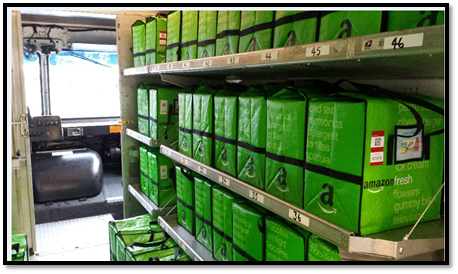
The typical operation seems to involve Amazon dropping off totes full of groceries and other packaged goods to USPS Destination Delivery Units (DDUs), where non-career City Carrier Assistants in turn deliver them early in the morning to customers' doorsteps.

Related articles:

Saturday, July 9, 2016

U.S. Postal Service Wants To Deliver More Groceries


The U.S. Postal Service wants to expand and extend its test of same-day grocery deliveries but isn't ready yet to take the venture nationwide.

The agency asked the Postal Regulatory Commission on Friday to extend the two-year test for another year, to October 31, 2017, and for permission to enter new markets. The venture serves select ZIP codes in the New York, Los Angeles, San Diego, Sacramento, Stamford (CT), and Las Vegas areas -- mostly in partnership with Amazon's "AmazonFresh" service.

"The Postal Service has determined that it will be necessary to continue the market test in a variety of metropolitan areas over the next year, in order for the Postal Service to make a final determination on the operational feasibility and the desirability of making Customized Delivery a permanent product," the filing said.

The USPS didn't state which new markets it would enter. The test is currently limited to annual revenues of less than $10 million, a restriction the USPS previously asked the PRC to waive. Actual profit and volumes from the program are not available to the public because of competitive issues.

The initial model involved non-career City Carriers Assistants delivering totes with groceries and other packaged goods to residences between 3 a.m. and 7 a.m. But postal officials have indicated they want to test additional delivery windows, as well as a variety of pricing structures.

The test is part of the Postal Service's multi-pronged effort to grow its package-delivery business to make up for declining volumes of traditional mail. That brings us to today's Publishing Word of the Day: Dead Tree Edition hereby renames the USPS the U.S. Parcel Service because of its focus single-minded focus on parcel delivery, to the detriment of traditional mail

If you're wondering what this has to do with publishing, you haven't been in a meeting with postal officials lately to discuss Periodicals service and pricing when all they want to talk about is their growing package business. The official USPS position is that it can't live on parcels alone, but try telling that to postal execs who sound so adversarial when it comes to the boring old letters and flats mail that still brings in most of the bucks.

Related articles:
 

Monday, July 4, 2016

The Four Horsemen of Publishing

Viktor Vasnetov's "Four Horsemen of the Apocalypse"
When publishers refer to The Four Horsemen, they usually mean Amazon, Apple, Facebook, and Google.

The concept of publishers having to joust with the fearsome, well-financed Four Horsemen started in the book-publishing industry. But the allegory is easily grasped by all publishers who warily view these web giants as, at best, frenemies.

The source of the moniker is the Four Horsemen of the Apocalypse from the New Testament's mysterious Book of Revelation, who usher in nasty waves of Pestilence, War, Famine and Death. You don't suppose we publishers are at all paranoid, do you?


This is the fourth in Dead Tree Edition's 31-part Publishing Word of the Day series that will be published throughout July. We guarantee you've never heard all of these words -- because some of them were dreamed up in our own devious little brains.

Tuesday, January 19, 2016

USPS Backing Down on Saturday Mail Delivery

Postal officials are ready to raise the white flag in their six-year battle to end Saturday delivery of letters and flat mail.

Postal-reform legislation with broad-based support is gradually taking shape in Congress, Deputy Postmaster General Ron Stroman told last week's meeting of the Mailers Technical Advisory Council (MTAC), according to PostCom Bulletin.

"In response to question as to what the USPS has compromised on in the legislative discussions with its stakeholders, Stroman said that 5-day delivery was one of the things the USPS dropped and that other things that used to be on its list are no longer there," said the bulletin, which is only available to members of the multi-industry Association for Postal Commerce (PostCom).

Congress members made it clear that getting approval for five-day delivery was "a politically difficult hurdle to overcome," the Bulletin quoted Stroman as saying. Postal officials dropped their Saturday plan in hopes of getting what they really need from Congress -- reform of so-called "prefunding" of retiree health benefits and of postal pensions.

In March 2010, the U.S. Postal Service released its Action Plan for the Future that called for ending Saturday deliveries, along with several other changes intended to prevent the agency from going bankrupt. Dropping Saturday deliveries would add $2 billion annually to the USPS's bottom line, postal officials claimed, though critics charged it was underestimating potential revenue losses.

Responding to concerns about delivery delays for critical items like mail-order pharmaceuticals, postal officials relented and said package delivery would continue on Saturdays. But Congress still didn't bite and continued to include a six-day delivery requirement in its annual budget.

The boom in e-commerce-related mail, including Sunday delivery of Amazon packages, has made curtailment of Saturday delivery an even harder sell. 

Related articles:


Saturday, September 12, 2015

10 Ways E-Commerce Is Reshaping the USPS

The E-commerce Revolution is reverberating throughout the U.S. Postal Service, but not in the destructive manner of other digital disruptions like email, online news, and electronic bill payment.

Largely, if not solely, because of online merchants, the agency’s “Shipping and Package” revenue is growing at a 10%-plus annual rate – no doubt a surprise to the digerati who for years have been predicting that the USPS would wither away into obsolescence.

One expert estimates Amazon now turns to the USPS to ship 40% of its U.S. sales, and that doesn’t even include packages that are handled by FedEx and UPS and then turned over to the Postal Service for final delivery.

The rapid growth and favorable prospects for such products as Priority Mail and Parcel Select are bringing about extensive changes to the agency’s operations, plans, and even how it thinks about itself.

Here are some of the ways the E-Commerce Revolution has already changed the U.S. Postal Service:

1) Endangered no more: “Postal worker” still appears near the top of nearly everyone’s list of occupations most likely to go the way of buggy-whip makers, but the lists are out of date. In response to declining mail volumes, the Postal Service endured year after year of downsizing, including 155,000 workers from 2007 to 2012. But the surge in e-commerce deliveries has derailed plans for further cuts, keeping employment levels steady the past three years.

2) Newbies: During the downsizing years, new hires were a rarity, but these days a retiring worker usually has to be replaced, typically by a non-career worker. The USPS’s hiring rate has tripled and its workhours devoted to training have doubled in the past four years. The agency has struggled to recruit new workers and bring them up to speed, acknowledging that the newbies are leading to more mis-delivered mail and on-the-job injuries.

3) Parcel-only routes: I haven’t seen any official statistics on the subject, but anecdotes indicate the USPS is delivering more parcels-only routes rather than the usual approach of having the same letter carrier deliver parcels, letters, and flat mail to the same addresses. One reason is that the agency’s aging fleet of LLV delivery vehicles is not designed for today’s heavy mix of parcels.

4) Renting vehicles: Another sign that the postal delivery fleet is overloaded: The Postal Service is in the process of lining up minivans and cargo vans that are “up to 2 tons capacity for delivery of packages and to fill in for vehicles out of service.” Exact numbers apparently have not been determined, but “during the holiday season one can anticipate that a single location may have a demand level of 50 to 100 vehicles.”

Concept for wifi-enabled cluster mailbox
5) Mailboxes: The USPS recently revised its standards for new residential mailboxes, shifting to a larger size that can accommodate more packages. It’s also trying out new designs for cluster boxes that can handle package deliveries, including ones that are wifi enabled. (In the near future, maybe your mailbox will send you a text saying “You’ve got mail – and a package too!”)

6) Financial strength: The headlines still say the Postal Service is losing money. But take away the Congressional accounting gimmicks and the agency has gone from the verge of insolvency to better-than-breakeven status in recent quarters, with growth in the Parcel Select and Priority Mail products playing a major role.

7) New delivery vehicles: With its stronger cash flow, the Postal Service has been able to accelerate the much-needed replacement of its aging delivery fleet. The new vehicles will have more space devoted to the growing flood of packages from Amazon, eBay, and other online sellers.

8) Non-mail: In the past year or so, letter carriers have been delivering an increasing variety of items that bypassed the usual postal network – such as groceries, cut flowers, fresh seafood, and bottled water. The volumes are generally small and limited to a few test markets, but the trend is toward letter carriers delivering more items that don’t have a stamp, meter mark, or postage label. 

9) Less focus on letters and flat mail: Mailers grumble that postal executives talk and think about nothing but packages these days, even though letters and other boring-ass traditional mail still bring in three-fourths of the USPS’s revenue. They say it’s no coincidence that First-Class Mail delivery has suffered – or that the most recent USPS annual report shows 14 photos of packages and only one that (barely) shows letters. 

10) Sunday: Just five years ago, postal officials were clamoring to shut down all weekend deliveries, though they eventually amended the proposal so that Saturday delivery of parcels would continue. But now Postal Service LLVs are a common site on Sunday in scores of cities, as 7-days-a-week delivery for Amazon has swept across the country since a market test early last year. And postal officials are talking about providing Sunday service for other merchants as well.

Related articles: 

Saturday, July 11, 2015

Is the Postal Service Primed for Amazon Prime Day?

Next Wednesday is Amazon Prime Day, a huge promotion that one postal expert predicts will overwhelm the U.S. Postal Service.

Amazon is celebrating its 20th anniversary on July 15 with a one-day online shopping event that will offer “more deals than Black Friday” to members of Amazon Prime, including those who sign up for a free 30-day trial membership.

“It will be interesting to see how USPS handles what is sure to be a major onslaught of Amazon package deliveries, with Amazon Prime two day shipping after the one day sale,” writes Lisa Bowes of Intelisent, a company that advises direct mailers. “Will Prime Day impact delivery for other classes of mail? My guess is – probably so…”

A look at the numbers indicates she is correct – that the Postal Service will struggle to handle the surge of Amazon packages without hurting delivery of other types of mail, even with massive overtime.

In a filing this week with the Postal Regulatory Commission, Amazon said it had 15 sortation centers at the end of 2014, with more on the way, that each prepare “tens of thousands” of packages per day to be handed off to the USPS for final delivery. That indicates that USPS delivers several hundred thousand “Parcel Select” packages to Amazon customers on a typical day. 

The e-commerce giant uses a variety of package-delivery services, but clearly the Postal Service is the favorite because of its ability to deliver to residential customers seven days a week at relatively low cost. Amazon has built an extensive logistics network that bypasses most of the Postal Service’s own network and delivers packages early every morning directly to the USPS’s destination delivery units (DDUs), where letter carriers pick up mail to be delivered later that day.

Membership: 30 million-plus and growing
An RBC Capital analyst estimated 10 months ago that Amazon had 30 to 40 million Prime members in the U.S. The numbers have probably been growing since then, and Prime Day seems likely to boost the membership roster.

Suppose that about 20% of existing U.S. Prime members take advantage of Prime Day and are joined by another 5 million who get a trial membership to take advantage of the deals. And suppose each Prime Day participant orders an average of two items, with half of them destined for “last-mile delivery” by the Postal Service.

That would mean letter carriers would handle 12 million packages, roughly 20 times their normal Amazon volume and more than double their normal daily volume for all Parcel Select packages. (That 12 million number is what we statistical experts call a SWAG, a Sophisticated Wild-Ass Guess. The actual numbers may be much higher or much lower, but with some reasonable – to me – assumptions, you can get a ballpark ideal of how Prime Day might affect postal operations.)

Amazon will have its own logistical challenges but also has opportunities to ease the pain. If the items likely to be hot sellers are spread throughout its network of distribution centers, it can probably hand off many of them to the Postal Service on Thursday, the day after Prime Day, rather than hitting the agency with one big wave on Friday the 17th.

It can also pull other levers, such as making exceptions to the two-day guarantee for certain items, especially those ordered late on Prime Day. And it can highlight deals on digital downloads (e.g. movies, music, e-books) instead of those requiring physical delivery.

The Postal Service has limited ability to handle a huge one-day surge, especially at what is usually a slow time of year when many career employees are on vacation and there are fewer temporary and part-time workers than during the Christmas rush.

Amazon Prime Day and its aftermath may be a challenging test of the Postal Service’s efforts to play in the e-commerce big leagues while still providing traditional mail delivery.

Related articles:

Saturday, June 20, 2015

USPS Grocery Delivery Coming to the Big Apple

Postal workers may begin early-morning delivery of groceries for Amazon in the New York metropolitan area by the end of this month.

Amazon grocery totes awaiting USPS delivery
The U.S. Postal Service filed a statement with the Postal Regulatory Commission on Thursday saying it “intends to expand the Customized Delivery market test to the New York City metropolitan area, on or shortly after June 29, 2015.” The USPS market test of grocery delivery on behalf of Amazon started last fall in the San Francisco area and spread to San Diego early this year.

Amazon’s “AmazonFresh” delivery service is already available in parts of New York City, with a fast-delivery promise: “Place your order by 10am and have it by dinner, or by 10pm and have it by breakfast.” And it already has an apparent pricing advantage in the Big Apple, undercharging three rival grocery-delivery ventures by at least 17%, according to a Nomura Securities International study.

The Postal Service will presumably take on some of those early-morning deliveries. It has told the PRC that its market test involves having non-career city carrier assistants deliver to a customer-designated location between 3 a.m. and 7 a.m. “without disturbing the recipient.”

The agency is already testing or about to test other rapid-delivery services in New York involving fresh fish, bottled water, and cut flowers.

Despite some objections about unfair competition with private enterprise, the PRC in October authorized a two-year test of Customized Delivery. But it has not acted on the Postal Service’s request to remove a $10 million annual revenue cap on the program.

Related articles:

    Monday, April 20, 2015

    Why Letter Carriers Are Not an Endangered Species

    “Mail carrier” was recently named as one of the 10 worst careers in the U.S., largely because of a supposedly bleak employment outlook.

    “Hiring of mail carriers has been on a steady decline with the proliferation of email and text messaging,” CareerCast said in ranking mail carrier #191 out of 200 careers. “Of all careers tracked in the 2015 Jobs Rated Report, mail carrier has the worst 10-year growth outlook.”

    CareerCast’s jobs outlook was based on a U.S. Labor Department projection that the number of mail carriers would shrink by 28% from 2012 to 2022. That’s no surprise: Just about everyone knows that digital technology is making letter carriers an endangered species.

    There’s just one problem with this scenario: “Just about everyone” is wrong.

    The number of people delivering mail for the U.S. Postal Service is actually growing slightly.

    It's true that since the end of 2012, the number of career USPS employees involved in mail delivery has dipped slightly, from 243,000 to 237,000. But the shrinkage all occurred during 2013; recent statistics show the number has stabilized or is rising slightly.

    And when non-career employees like city carrier assistants (CCAs), are included, mail delivery looks like a growth field. That, plus the high turnover among CCAs, is why “We’re hiring!” signs are popping up at many post offices.

    USPS statistics don’t provide apples-to-apples comparisons of non-career employee counts, but the numbers on hours worked are a good proxy. So far this year, the straight-time hours worked by all (both career and non-career) “city delivery carriers” are up 5% from two years ago, while the hours for all “rural carriers” have increased nearly 3%.

    Digital technology taketh away, and . . . 
    What “just about everyone,” including the Labor Department, seems to miss is that digital technology – specifically, online purchasing – is adding work for the Postal Service’s carrier force. When stuff is bought online, someone has to deliver it.

    And when that delivery is to a residential address, chances are that the “final mile” is handled by a USPS letter carrier even if the package was sent via UPS or FedEx.

    The Postal Service is doubling down on its unique ability to reach every residential address. It has slashed some Priority Mail prices for frequent shippers and is testing rapid delivery of everything from fresh flowers to groceries.

    Outgoing Postmaster General Pat Donahoe hinted late last year that Sunday delivery of packages would soon become the norm, not just something USPS does for Amazon in select markets.

    So all indications are that the number of packages delivered by letter carriers will continue growing, which is why specs for USPS’s new delivery vehicles call for more storage space. Those packages are far more labor intensive than traditional mail; Priority Mail boxes don’t end up in nice walk-sequenced trays or carrier-route bundles.

    And even the labor savings from the gradual shrinkage of traditional mail mostly get canceled out by continuing growth in the number of delivery addresses.

    The big threat
    The big threat to employment levels for USPS carriers is possible curtailment of Saturday delivery of letters and flats. But that would put only a sizable dent – nowhere close to a 28% reduction – in letter-carrier employment levels.

    And it continues to face rough going in a reluctant Congress, where members have recently been getting an earful from constituents about slow delivery.

    So don’t put letter carriers on the endangered-species list just yet. (There may be good reasons to put “mail carrier” on the list of 10 worst jobs, as I'm sure some postal workers would be happy to explain, but employment prospects are not one of them.)

    The moral of the story: Beware of projecting past trends into the future, especially when the recent past runs counter to those projections.

    Related articles:

    Tuesday, April 14, 2015

    Yo, Mailman, Bring Me a Flounder and a Dozen Roses

    From dropping off water bottles to running a concierge service, the U.S. Postal Service is increasingly venturing into activities that have little to do with traditional mail delivery

    A MailMyWay promotion
    What's next, Postal Pizza?

    The U.S. Postal Service’s recent experiments with new lines of business include delivering fresh fish, flowers, cases of water, and ready-to-cook meals.

    In St. Louis, the agency is even trying out a “concierge service” called MailMyWay that picks up unpackaged items, places them into Priority Mail Flat Rate boxes, and mails them.

    With traditional letter mail in slow decline, the Postal Service is eager to bolster its finances by developing new lines of business that leverage its massive delivery network and capabilities.

    But getting such ventures off the ground is not always easy or simple. USPS and 1-800-Flowers announced a deal in late 2012 but only now are getting ready for a limited test in New York.

    U.S. Postal & Rehydration Service
    That will be on top of two existing NYC tests – delivery of fresh and frozen seafood for the famed Fulton Fish Market and next-day delivery of bottled water for Nestle. (Why try out these ventures in the nation’s most populous city? Hey, if you can make it there, you can make it anywhere.)

    USPS’s same-day delivery service, MetroPost, is being tested in New York and Phoenix, with plans for expansion to 1,800 ZIP codes all across the country, Ed Phelan, Vice President of Delivery Operations, told a recent gathering of mailers.

    Sunday delivery of packages for Amazon has been growing rapidly, with the e-commerce giant “looking at expanding the service to all serviceable ZIP codes across the country,” Phelan’s presentation said. That has USPS examining where it can place more delivery hubs for the service.

    Another growing Amazon-USPS partnership is Amazon Fresh, which delivers groceries to doorsteps in parts of the New York, Los Angeles, Seattle, and San Francisco areas.

    “We're branching out as fast as we can while being careful not to sacrifice the quality and convenience our customers expect,” says the Amazon Fresh web site. The service is coming soon to Washington, DC; Portland, Oregon; and Sacramento, according to USPS.

    Amazon Fresh totes awaiting delivery
    Phelan also said the Postal Service is providing deliveries for Blue Apron, which sends chilled meal-ingredient packages with recipes to its subscribers.

    The question for USPS’s traditional clientele – you know, the folks who send out, like, letters and stuff that go into actual mailboxes – is whether the new ventures will strengthen the Postal Service’s finances or distract it from serving the customers who still pay most of its bills.

    Related articles:


    Monday, January 12, 2015

    You Won't Believe What This Fortune Teller Predicts for Publishing in 2015!

     Smart phones, not-so-smart publishers, and hot new trends: 24 crazy predictions for the new year

    Media consultant
    When glancing at my article in the current issue of Publishing Executive, I had a revelation: Now that one of the publishing industry's leading magazines had called on me for predictions, I’ve graduated from blogger to media pundit.

    And then my heart sank as I realized I had violated a cardinal rule of the International Order of Pompous Media Pundits: In its six-plus years of existence, Dead Tree Edition had never published a year-end list of predictions for the coming year.

    With 2015 already under way and prognostication being new to me, I scraped up 50 bucks – Dead Tree Edition’s entire annual research budget – and headed over to Madame Marie, a local fortune teller and door-to-door magazine saleswoman.

    Here are her 24 startling (mostly) predictions about magazines, the three Ps (postal, paper, and printing), social media, and publishing in general for 2015. If some turn out to be true, you can be sure I’ll be writing “told ya so” pieces in the next 12 months. And you can blame the wrong ones on Madame Marie:

    1) Postal rates will not decrease, even though the exigent surcharge is set to expire this summer. Not sure if that will be from a court order or Congressional action. When I asked Madame Marie to explain, she responded, “What, you think I have crystal ball or something? All I know is, don’t ever bet on government getting rid of a temporary tax or fee.”

    2) More web sites will jump into the printed magazine business. But they will not be welcomed into the fraternity of consumer-magazine publishers because they won’t have bloated ratebases or sell annula subscriptions for $5.

    A postal bankruptcy would be, like, a bummer, man.
    3) Three-dimensional printing will grow almost as fast as the buzz about it. By June, ad agencies will start demanding makegoods if their clients’ magazine ads aren't printed in 3D.

    4) USPS will announce a new strategic plan called Seven Six Three – delivering Amazon packages seven days a week, other parcels Monday through Saturday, and everything else three days a week.

    5) If you think native advertising is bad, wait until you see foreign-born advertising.

    6) Mark Zuckerberg’s new book club will spread like wildfire, until people start seeing spammy “sponsored” posts and photos of distant acquaintances’ new puppies in their books.

    7) Despite a decent economy, the market for huge yachts will plummet as billionaires join in the new craze for tasteful displays of wealth – buying a daily newspaper. When I asked Madame Marie whether the newspapers would still struggle, she said, “If you have to ask how much money they will lose, you can’t afford to buy a newspaper.”

    8) Congressional Republicans will try to push the U.S. Postal Service into bankruptcy to break the postal unions – until voters realize a USPS bankruptcy would turn Forever Stamps into Never Stamps.

    BoSacks flyin' high: Our consultant's
    source of inspiration and insight
    9) Congress’ next attempt at postal reform will be putting USPS up for sale. FedEx and UPS will quickly say, “No thanks.” However, the idea of buying out the middleman will intrigue Amazon, until it runs the numbers and realizes that, with proper accounting for pensions and retiree benefits, the Postal Service would be profitable. And you know how Amazon hates profits. To console himself, Jeff Bezos will buy another newspaper.

    10) Amazon will go back to working on delivery drones.

    11) Wal-Mart will announce the development of anti-drone missiles that can be mounted on store rooftops.

    12) A major publisher will redesign its web site, then realize the snazzy new look and upgraded user experience can’t be seen on smartphones, which represent 80% of the site’s visitors.

    13) “Big data” will be so hot that tech companies will try to differentiate themselves with new projects involving “Really Big Data,” “Huge Data,” and “Massive Data.”

    A source of insomnia -- and much cursing
    14) Tablets will be linked to insomnia. We’re not talking about the recent study proving that using e-readers before bedtime disrupts people’s circadian rhythms and makes it hard to fall asleep. (That’s so 2014!) We’re talking about MediaVest, the ad agency that is refusing to pay for the portion of a magazine’s circulation distributed via tablet editions. As Madame Marie put it, while meditating on a 1978 copy of High Times with the BoSacks centerfold, “Magazine advertising executives will stay up all night wondering whether to grow a pair and tell MediaVest it needs a rectal-cranial extraction.”

    15) With tight supply, rising prices (for now), and strong dollar, the U.S. will be the market of choice for manufacturers of coated paper around the world. Because of low energy costs and the recent shuttering of inefficient mills, North American producers will be able and willing to protect market share by cutting prices.

    16) As usual, “that damned newsstand” will be a frequent utterance of magazine publishers. But in 2015 the phrase will refer to the long-neglected Apple Newsstand for marketing iPad editions of magazines. The regular newsstand system – the one that sells printed magazines – will actually register gains in 2015 after years of declining sales.
    Google What?

    17) The content-marketing bubble will burst when non-publishing companies realize how few people are viewing their content and that it's not generating actual sales. Some will find it more efficient to use -- perish the thought -- paid advertising.

    18) Trying to ride the next big wave, a former content-marketing/social-media/SEO consultant will publish a book called How Publishers Can Profit From Chris Christie-sized Data.

    19) Web advertisers will have a radical idea: Only pay for ad impressions that are seen by actual human beings.

    20) Google will pull the plug on Google Plus. No one will notice the difference.
    The next big thing in social media

    21) The big news in social media will be a simple new app that lets people share their pain and disappointment by sending out messages saying, simply, “Oy!”

    22) Magazine publishers will pour lots of resources into cool new ancillary enterprises that they will brag about at industry conferences. A few of these ventures will actually turn a profit.

    23) Some magazine ads will still include QR codes. And consumers still won’t bother scanning them.

    24) “Oh, one last thing,” added Madame Marie, still clutching her sacred copy of High Times. ‘Linkbait’ headlines designed to exploit people’s curiosity will take over the Internet. Even your blog will join the trend.” She’s already been proven right on that one.

    Saturday, October 11, 2014

    Third Bush on the Right, Please: USPS Grocery Deliveries Would Need Lots of TLC from Carriers

    Mail carrier was recently named the most endangered job in the U.S., but the U.S. Postal Service seems to have other ideas. Its plan to deliver groceries to households in major metropolitan areas is the latest among several strategic moves that would mean more work for employees who handle the "last mile" of delivery.

    Please, Mr. Postman, look and see,
    Are there some groceries in a tote for me?

    The Postal Service’s proposed market test of same-day grocery deliveries, apparently in partnership with Amazon, would require even more TLC on the part of USPS’s carrier force than normal deliveries, the agency revealed this week in filings with the Postal Regulatory Commission.

    “All Customized Delivery items will be transported directly to a customer’s door and will be delivered [between 3 a.m. and 7 a.m.] without disturbing the recipient,” USPS revealed to the PRC. “Customized Delivery also will allow recipients to provide specific delivery instructions.”

    Back door man
    “Carriers would need to go to each delivery door and manage customer specific delivery instructions.” To avoid theft of the early-morning deliveries, such “special delivery instructions” could conceivably include placing the special grocery-filled totes at back doors, in hallways, into parked cars, or even behind bushes. Undeliverable totes would be returned to the shipper.

    “Participants will pay a fee for the Customized Delivery Service,” USPS wrote. UPS is reportedly close to rolling out a service that, for a $5 fee or a $40 annual membership, would deliver someone’s packages to a nearby store instead of to the home.

    The Postal Service has recently been encouraged to enter a wide variety of new ventures, most notably providing banking services to the poor and to rural residents. But postal executives’ new-revenue plans are all focused on leveraging the agency’s massive, every-address delivery network: not only by serving the grocery business but also with Sunday deliveries for Amazon, aggressive price cuts on lightweight packages sent by large mailers, and seeking legislative approval to deliver wine and beer.

    All of those growth efforts are far more labor intensive – and higher priced – than USPS’s traditional job of delivering letters. The Postal Service is also adding thousands of new delivery points every day, requiring more travel time for carriers even if mail volumes don't grow. So it's premature to assume that letter carriers will soon go the way of buggy-whip makers.

    Market disruption? 
    To gain the PRC’s approval for its proposed two-year “Customized Delivery” market test of grocery delivery, USPS must show that the venture would not disrupt existing markets or rely on “unfair” competitive advantages over private businesses.

    Starting later this month, USPS wants “to test and develop a long-term, scalable solution to enable expansion of customized delivery to additional major metropolitan markets across the nation.” It might also test other delivery times during the day.

    “The Postal Service will negotiate price with each customer [presumably the grocer, not the consumer], in part, based on the pickup schedules specific to each customer.” USPS also hopes the test will determine “the optimal pricing structure for this type of service.”

    San Francisco test  
    The agency recently conducted a smaller-scale test of grocery delivery in the San Francisco area. City carrier assistants – non-career postal employees – delivered about 160 totes per day to 38 ZIP codes, according to postal officials.

    “In the current process,” USPS told the PRC, “the retailer brings groceries already packed into retailer-branded totes, some of which are chilled or include freezer packs, directly into Postal Service destination delivery units (DDUs) between 1:30 a.m. and 2:30 a.m."

    “The totes are all the same size and color, and have a QR code on the outside. The Postal Service receives a manifest file from the retailer containing the address and QR code number for each tote. This file is used by the Postal Service to dynamically route totes and create a line of travel for each route.”

    “These deliveries are unattended — the CCA will not ring the doorbell or knock on the door. The carrier places the totes in a location designated by the consumer for delivery.

    “Totes are scanned [sometimes with an iPhone] at key steps in the process to provide tracking and visibility through to delivery. CCAs wear postal uniforms and lighted caps as a safety measure and for easy recognition by the public.”

    [Editor’s note: Perhaps such lighted caps should also be provided to carriers who have to make normal deliveries after sunset during the winter months.]

    Related articles: