Showing posts with label postal rates. Show all posts

Thursday, January 24, 2019

USPS Proposal Could Spread Pain to Catalogs

Comail is working. But in Postal Land, no good deed goes unpunished.

Like lashing two water-tight boats to a sinking vessel.
The good news — for mailers, printers, and the U.S. Postal Service — is that flat Standard Mail is being sorted far more efficiently than it was just two years ago. 

The bad news is that the trend is prompting postal officials to consider a proposal that would almost certainly lead to higher-than-normal rate increases for efficiently mailed catalogs and other Standard flat mail.

Some postal experts fear the proposal would lead to reduced incentives for co-mailing, which even postal officials admit is the main reason that highly efficient – and profitable – “High Density Flats” volume has grown by 45% in the past two years.

More bad news: Postal officials can’t explain -- and don’t seem to be trying very hard to understand — why the Postal Service’s costs of handling most types of Standard flat mail have skyrocketed in the past year. That trend also threatens to cause higher rate increases even for efficient mailers.

Although the Postal Service is supposed to act like a business, this is a case of it operating like a bureaucracy where CYA trumps ROI.

Hall of mirrors

Let me walk you through the strange hall of mirrors where postal officials are ready to shoot themselves in the foot rather than celebrating, and building on, a successful tactic.


The Postal Regulatory Commission and legal challenges have pressured the Postal Service for years to do something about what is essentially a subsidy for the least-efficient flat Standard mail – the mail that does not meet the 10-piece minimum to create a carrier-route bundle. (Note: The USPS refers to such mail by the misleading moniker “Flats,” but for the sake of clarity Dead Tree Edition calls it “Non-Carrier-Route Flats.”)

The USPS has responded by imposing slightly higher rate increases for such mail than for most other Standard classifications. In Fiscal Year 2018, for example, revenue per piece rose less than 1% for the Standard class as a whole but was up 5.1% for Non-Carrier-Route Flats mail. But the cost per piece rose 13.4%, putting the category further into the red, with revenue covering only 68.65% of costs.

Got no explanation

In a recent report, postal officials speculated that, because of economies of scale, a 17.5% drop in volume for Non-Carrier-Route Flats during FY2018 caused the category’s costs to spike. (See pages 17-18 of this PDF.) But that simplistic theory doesn’t explain why the cost per piece for Standard Carrier-Route Flats rose even more, to 15.2%, when volume for that category dropped only 1.4%.

(Don't blame postal workers: The agency's average cost per labor hour has recently been increasing less than 4% annually.)

These unexplained cost increases have caused the cost coverage for Carrier-Route Flats to decline from 137.53% to 108.49% in just two years. Postal officials have not explained that dramatic trend, which could soon turn what was a highly profitable category for the USPS into a money loser.

“Based on feedback from industry representatives, which is supported by volume trends, flats volume has migrated from the Flats and Carrier Route products into High Density Flats because of comailing,” the USPS report said.

True. Better incentives have encouraged more comailing, a process that sorts a variety of mail pieces -- mostly catalogs and magazines -- into a single mailstream to take advantage of postal discounts. The work is typically done by printers, which are rewarded with a share of their customers' resulting postal savings.

High Density Flats are like Carrier-Route Flats on steroids, with a minimum of 125 pieces per carrier route. Achieving a significant proportion of such mega-bundles typically requires a mailing list – or a comailing run – with at least several million addresses.

It's working. Now let's screw it up.

The rapid growth of High Density Flats is good news for the Postal Service because of the category’s 131.20% cost coverage. That’s the kind of trend rate incentives are supposed to produce.

But postal officials are focusing on the phantom “problem” that the move to High Density Flats is allegedly causing: the reduced efficiency of Non-Carrier-Route Flats. The “solution” they are considering, they revealed recently, is to combine Non-Carrier-Route Flats, Carrier-Route Flats, and High Density Flats into a single category known as Non-Saturation Flats. (See pages 20-22 of this PDF.)

“In a way, the USPS is suggesting that if it lashes two water-tight boats to a sinking vessel it will save the sinking ship,” the Mailers Hub newsletter quipped this week.

No longer would postal officials be pressured to get Non-Carrier-Route Flats “above water,” which would require either massive (and, in some circles, unpopular) rate increases or massive cost reductions. This poorly sorted mail would become part of a larger category with more palatable cost coverage of 88%.

But two profitable categories – High Density Flats and Carrier-Route Flats – would also join that slightly unprofitable new category. Based on the Postal Service’s history, we know what will come next: Postal officials will spread the pain around, jacking up prices across the category, even on the types of mail that would be considered highly profitable if not for this bureaucratic finagling.

(That already happens in the Periodicals class, where efficient and inefficient mail are in a single category in which efficiently mailed publications subsidize the inefficient ones.)

Increasing the price spread between efficient and inefficient mail has prodded more mailers to participate in comail and more investment by printers in enhancing the process. By the same token, freezing or shrinking the price spread by having efficient mail subsidize inefficient will curb the favorable trend.

Iceberg off the starboard bow

What really galls the postal experts I’ve spoken with recently is that the Non-Saturation Flats proposal looks like an attempt to paper over some very real problems – what one postal expert called “re-arranging the chairs on the Titanic deck” -- instead of understanding and addressing them.

Postal officials don’t understand the cost trends with flat Standard mail, don’t know whether their various efforts to improve the handling of flat mail are working, and can’t even say when they will know.

Their explanation of the cost increases for Non-Carrier-Route Flats are simplistic and probably off base. (Note to the USPS: Here’s a hint in your own data: The proportion of Non-Carrier-Route Flats dropshipped to the SCF level has declined from 64.1% to 51.7% in just two years. If you actually dig into the category’s data, I’ll bet you’ll find much less relatively inexpensive mail, such as dropshipped 5-digit bundles, and a higher proportion of poorly sorted, non-dropship mail.)

Postal officials’ explanation of the even larger cost spike for Carrier-Route Flats is non-existent. Here’s why: A big culprit is probably the money-eating Flats Sequencing System, but postal officials won’t admit that or even discuss trying to unwind the FSS fiasco. Doing so would force them to shoulder the blame for rushing into the multi-billion-dollar investment before it was proven to be workable. The unofficial motto at L’Enfant Plaza is “Never recalibrate, just obfuscate.”

(Another note to postal officials: I dare you to publish a clear analysis showing the cost-per-piece of handling and delivering FSS mail – including the stuff the machines aren’t able to sort – with the costs of carrier-route and 5-digit-bundle mail. No, I take that back. I double-dare you.)

Related articles:


Monday, January 1, 2018

Trump Is Wrong, Mostly, About Amazon and USPS

Low rates don't mean unfair rates. But do Amazon deliveries create hidden costs for the USPS?

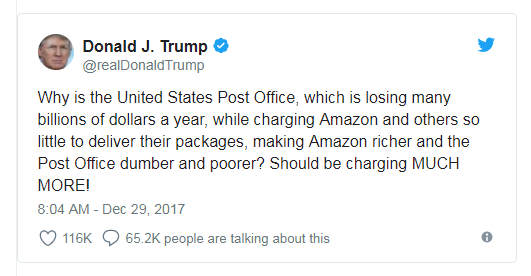
President Trump was off base Friday when he implied that Amazon has a sweetheart deal with the U.S. Postal Service.

But for reasons unrelated to Trump's' charges, it may be time for the USPS to rethink the prices it charges Amazon and perhaps for all package deliveries. In fact, there’s evidence the Postal Service is already doing that.

While containing no outright falsehoods, Trump’s tweet is a mix of truth and debatable claims.

Let’s take apart his claims:

• The USPS is “losing many billions of dollars a year”: Officially, that’s true, but only because the Postal Service is indirectly subsidizing the federal government via prepaid retiree health benefits and by paying more than its share of combined federal/USPS pension costs. Absent those accounting gimmicks, the Postal Service has operated at about breakeven the past few years.

• The USPS “is charging Amazon and others so little to deliver their packages”: True, but it's a non-issue. The USPS is generally able to charges the lowest rates for residential parcel deliveries it's the low-cost provider.

• “Making Amazon richer”: The Postal Service’s moves to gain a larger share of the residential package market have definitely benefited Amazon – and plenty of others who ship packages. Competition tends to do that. It's called capitalism.

• The Amazon deal is making the USPS “dumber.” Not likely. The USPS can learn from Amazon’s sophisticated approach to logistics.

• The Amazon deal is making the USPS “poorer.” Not according to the Postal Regulatory Commission, which vets package-delivery rates, including those negotiated privately by the likes of Amazon, to ensure they are profitable for the Postal Service.

Trump isn’t the first to question the low postage rates Amazon pays. Various commentators, special-interest groups, and others have raised the issue from time to time.

Challenges to the Amazon deal fall into three categories: the “sweetheart deal” argument, the “unfair competition” argument, and our own Dead Tree Edition observations.

The “sweetheart deal” argument
Those who claim Amazon negotiated too sweet a deal with the Postal Service naively point to estimates that its postage rates are well below those paid by mom-and-pop shippers. A Wall Street Journal op-ed written by the head of “a money-management firm that owns FedEx common stock” (Hmm, any bias there?) typifies the muddled thinking:

“The U.S. Postal Service delivers the company’s boxes well below its own costs,” wrote Josh Sandbulte, who estimated that the USPS handles about two-thirds of Amazon’s U.S. deliveries. “Select high-volume shippers are able to drop off presorted packages at the local Postal Service depot for “last mile” delivery at cut-rate prices. With high volumes and warehouses near the local depots, Amazon enjoys low rates unavailable to its competitors.”

In other words, Amazon goes to great expense to minimize the USPS’s costs of delivering Amazon packages; in return, Amazon pays lower postage rates. Such “worksharing” discounts are a standard, and quite logical, part of most postage rates: The more you do to reduce the Postal Service’s costs – via sorting, dropshipping, efficient packaging, etc. – the lower your postage bill.

Amazon presented the chart below to the PRC early this year in defense of its low rates, saying it “has established a transportation and distribution network of more than 25 sort centers and more than 70 fulfillment center warehouses. This network enables Amazon to inject parcels at Postal Service Destination Delivery Units (“DDUs”) already presorted for delivery to the customer.”


“This arrangement," Amazon says, benefits the Postal Service by letting it make more efficient use of its delivery facilities, equipment and personnel while avoiding the costs of building additional capacity in the Postal Service’s upstream network.”

The “unfair competition” argument

FedEx itself, along with fellow USPS competitor United Parcel Service, has a more sophisticated argument – that parcel shippers aren’t paying their fair share of the Postal Service’s costs.

Imagine that a letter carrier delivers four pieces of mail and one Amazon package to a particular address. The “fair-share” camp says that at least 20% of the labor, fuel, and other costs required to make that delivery should be assigned to the package.

But the USPS only looks at the incremental costs of delivering packages and other “competitive” products. For example, the labor and fuel required to drive to the mailbox are not factored into the cost of (or price for) delivering the package because those costs would exist even if the carrier were only delivering the letters.

The result, say USPS’s competitors, is that the Postal Service undercharges package shippers while overcharging those who send letters and other traditional mail. But the PRC sides with the USPS.

Dead Tree Edition's observations
The USPS-PRC approach to pricing isn’t just consistent with the law, it's good business practice.When evaluating a product, the question is whether the organization would be more profitable without the product than with it. That means ignoring any costs that would remain if the product were discontinued.

But the USPS-PRC approach has a couple of shortcomings.

Because its tiny 30-year-old delivery vehicles were designed primarily with letters in mind, the Postal Service is increasingly relying on parcels-only delivery routes to cope with the e-commerce boom. That’s driving up the average cost of delivering a parcel.

But setting postal rates is a bit like driving while looking in a rear-view mirror: Projections are based on elaborate analyses of historical data – in this case of a time when most parcel deliveries could easily be piggybacked onto regular mail routes. It’s also unlikely that the Postal Service’s current cost models fully reflect the increasing amount of real estate devoted to sorting and handling parcels.

And it’s well-nigh impossible for those models to factor in opportunity costs.

The USPS’s deals with Amazon have been based on the premise that most of the additional deliveries would be done by city carrier assistants (CCAs), whose compensation is less than half that of career letter carriers. The labor contract with the National Association of Letter Carriers caps the number of CCAs the USPS can hire, while allowing additional ones to be brought on for non-traditional ventures like the Amazon deals.

But, contrary to its expectations, the Postal Service has struggled to hire, train, and retain the full complement of CCAs. The parcel boom has also meant plenty of work – and overtime -- for CCAs and career carriers alike.

Under these conditions, the Amazon deal is sucking up a limited resource: inexpensive (about $17/hour) CCA labor. That deprives the Postal Service of the cost-reducing opportunity to use more straight-time CCA hours on non-Amazon deliveries.

Here’s a hint that the Postal Service may be wising up to such hidden costs: A small experimental venture that had CCAs delivering groceries for Amazon Fresh apparently collapsed recently. One reason, Recode reports, is that “Amazon balked at new delivery rates USPS was going to charge the company.”
"The bottom line is whether the USPS would be better off without Amazon than with it."
Still, Amazon pays the U.S. Postal Service billions of dollars annually – probably well over 10% of the agency’s total revenue. The bottom-line question is whether the Postal Service would be better off without the current Amazon deal than with it. The answer is neither the clear "no" that Trump and other critics would have us believe, nor the clear "yes" indicated by the PRC’s rulings.

In fact, I doubt anyone can provide a definitive answer.

Related Dead Tree Edition articles include:


Saturday, August 26, 2017

Postal Service Eyes January Rate Hikes

The U.S. Postal Service is planning to raise virtually all rates a bit in January, apparently including a one-cent hike of the Forever Stamp, to 50 cents. And it’s also hoping it will soon get the power to implement larger rate hikes.

The USPS will raise rates for both market-dominant mail (such as First Class and Marketing Mail) and competitive mail (such as Priority Mail) on Jan. 21, 2018, postal officials told mailing-industry representatives this week.

The average rate increases for market-dominant classes are limited by an inflation-based cap, currently close to 2%. A postal official indicated that rates would rise from 1% to 3% for most market-dominant products, according to attendees at a meeting of the Mailers Technical Advisory Committee.

Postal officials didn’t spell out what any of the new rates would be. But a statement that the increase for letter mail would be about 2% almost certainly means that the price of the popular Forever Stamp for First Class letters will rise from 49 cents to 50 cents (a 2.04% hike).

The new rates for flat Marketing Mail and Periodicals would provide greater incentives to create efficient mailings, which is good news for catalogs and magazines that are co-mailed, as well as for printers that provide co-mail services. But it means higher-than-average rates for small publishers that don’t take advantage of such mail-consolidation programs.

The USPS is most likely to file the new rates with the Postal Regulatory Commission in October. As long as the PRC determines that the USPS proposal meets certain standards, such as not violating the price caps, the new rates will take effect without modification.

Next month, the PRC is slated to announce the results of its 10th anniversary review of the law that created the price cap. If it determines that the law’s system for regulating market-dominant rates is not meeting the law’s objectives, the PRC can modify or replace the system.

Postal officials argue that, because the system fails to meet the objective “to assure adequate revenues . . . to maintain financial stability,” the PRC should loosen or eliminate the price cap. But a significant PRC overhaul of the rate-making rules would probably lead to legal challenges that could delay implementation of any changes.

Related articles:

Thursday, June 1, 2017

Mailers' Groups Blast NALC Deal

Three mailers' organizations blasted a labor deal with the National Association of Letter Carriers today as proof that the “spendthrift monopolist” U.S. Postal Service “cannot be counted on to control its costs or prices.”

“Rather than bringing compensation more in line with the private sector – as required by postal law – the tentative agreement with NALC worsens the problem,” said a joint statement from Postcom—The Association for Postal Commerce, MPA—The Association of Magazine Media, and the Alliance of Nonprofit Mailers.

In defending the current inflation-based price cap on most postal rates, the statement said, the coalition has presented expert testimony showing "that postal workers are paid nearly twice what the private sector pays for similar work."

“The NALC contract confirms that the Postal Service cannot be trusted to make the tough decisions needed to control its own costs.”

The collective bargaining agreement released May 12 would give career letter carriers three pay raises totaling 4.7% over the 40-month life of the contract in addition to seven cost-of-living adjustments. The three mailers groups indicated that the Postal Service didn’t get anything in return for the generous pay package, such as the ability to save money by filling openings with more low-paid non-career employees.

Keeping the cap on CCAs
“Instead of continuing a shift to lower-cost employees, the agreement converts many City Carrier Assistants (“CCAs”) to career status and preserves existing narrow limits on the total number of CCAs that the Postal Service may employ,” the statement said.

“The NALC deal is only one of a recent series of collective bargaining agreements that widen the postal employee compensation premium rather than narrowing it.” The NALC says the contract would cover 213,000 active employees if the union’s members ratify it.

“It is commendable that USPS provides stable, middle-class employment for a large number of employees, but substantially over-compensating them, and paying for this with above-inflation rate increases for mailers, is inappropriate and jeopardizes the whole enterprise. There are proven ways to rein in excess labor costs without disrupting the lives of existing employees,” the coalition's statement said.

Postal officials are seeking legislative relief from the 10-year-old law that keeps rate increases proportional to changes in the Consumer Price Index. But the coalition, along with other mailers, argues that the cap has forced more financial discipline on the USPS and prevented it from imposing large rate increases that would hurt both mailers and the Postal Service itself.

Related articles:


Sunday, October 16, 2016

New Postal Rates Will Benefit Some Publishers and Printers

Mail that's been sorted by an FSS machhine.
A quiet boycott by some mailers helped persuade the U.S. Postal Service to change how it charges for publications, catalogs, and other flat mail.

As a result, many mailers will pay lower postage bills next year, printers will earn more money from their co-mail programs, and the USPS is likely to benefit as well.

The USPS announced on Wednesday average rate increases of slightly less than 1% for First-Class, Standard, and Periodicals classes, to take effect on January 22. But some customers, including the most efficient mailers of magazines and catalogs, will apparently see their postage bills drop.

The new rate structure will do away with a change first introduced a year and a half ago – separate Standard and Periodicals rates for ZIP codes served by the Flats Sequencing System. FSS rates are higher than rates for non-FSS pieces that are in carrier-route bundles but lower than other non-FSS rates. There was a logic to the separate FSS rates, but they backfired for the USPS.

“Many mailers who previously paid Carrier Route rates for their FSS volume experienced an above average price increase after the new rates were introduced in May of 2015,” the Postal Service said in explaining the new Standard Class rates.

Rate change led to partial boycott
“Since then, FSS volume has declined faster than the volume in other categories of flat-shaped mail” because catalog companies “have significantly curtailed the number of pieces sent to potential new customers (prospecting pieces) in FSS zones. Additional feedback indicates that other flats mailers may be engaging in similar cost mitigation strategies to avoid sending certain pieces in FSS zones.”

Periodicals mailers have little opportunity to engage in similar FSS-avoidance schemes. But publishers, like cataloguers, were talking of legal action a few months ago to prevent the Postal Service from shifting more ZIP codes to FSS, arguing that would in essence be an illegal rate increase.

The new rates would eliminate that controversy. Standard and Periodicals rates will be identical in FSS and non-FSS ZIP codes, so the USPS can move forward with shifting more areas to FSS without pushback from its customers.

The additional volume is exactly what postal officials say the giant FSS machines need to run efficiently. And by restoring some of the incentives to co-mail, the new rate structure should result in flat mail being presented to the USPS in more efficient packages and closer to the point of delivery.

One  failure, one success
Two major investments have been made this century in reducing the costs of handling and delivering flat mail pieces – USPS’s $1.4-billion Flats Sequencing System and the publication-printing industry’s massive expansion of co-mailing.

The FSS so far has failed. But co-mail – consolidating mail from a variety of customers in a way that reduces both the mailers’ and the Postal Service’s costs – has been a huge success.

Such a success, in fact, that it has undercut the ROI of FSS. Thanks to co-mail, more than 70% of flat Standard and Periodicals mail going to non-FSS zones is in carrier-route bundles, up from less than 50% when FSS was first planned. That means much of the Postal Service’s expected savings from FSS have already been achieved via co-mail.

By reducing the incentives to co-mail, the FSS rates actually undercut what the printers achieved. But the January rate structure will restore and actually enhance the incentives to co-mail.

For example, the Periodicals piece rate for copies that are in carrier-route bundles will not change, but the rate for copies in the next-best category will rise by more than 3%. That means the minimum savings from promoting a copy to carrier route will rise from 9.8 cents to 10.7 cents. Printers that use co-mail and other techniques to bring about such shifts typically get a share of their customers’ postal savings.

For publishers that have a high percentage of copies in carrier-route bundles, the savings from eliminating the FSS rates will outweigh the higher rates for less efficient copies – resulting in lower average postal rates.

The picture for Standard flats, such as catalogs, is more complicated. But again it appears that the incentives to improve mail sortation will be greater and that the most efficient mailers will enjoy lower postal bills.

Related articles:

Saturday, July 16, 2016

Why the Rate Cap Isn't Killing the Postal Service

The rate cap is evil -- evil, I tell you!

A legislative reform that has arguably saved the U.S. Postal Service is increasingly coming under attack by wrong-headed postal officials and some of the postal unions.

The myth these whiners are spinning is that the inflation-based rate cap on most postal rates is a horrible evil that is holding the USPS back. These cap carpers describe the recent expiration of the USPS’s exigent surcharge as a moral outrage.

The Postal Service, they claim, should be able to enact higher rate increases so that it can cope with the loss of mail volume to digital alternatives.

But that’s not how the real world works. What the cap carpers (our Publishing Word of the Day) miss is that no business gets to paper over its problems by raising prices as much as it wants to – especially other businesses that suffered from the Digital Revolution. As Joe Schick, Director of Postal Affairs for major publication printer Quad/Graphics, wrote in response to a cap carp comment on a recent Dead Tree Edition article:

“While postal prices have been capped at CPI [Consumer Price Index] for Market Dominant Products over the last 10 years, postage as a percent of the total cost to produce and distribute magazines and catalogs has still increased from about 35% to 60%. That means the other segments (printing and paper) have seen price decreases, which is a big reason why there has been major consolidation in the industry.”

(I guess that means the printers didn’t get an “exigent” rate increase to help them recover from the recession, the way the Postal Service did.)

Before the rate cap and other postal reforms were enacted in 2006, changing postal rates was an arduous and unpredictable affair. After many months of legal proceedings, the new rates often bore little resemblance to what the Postal Service proposed.

The rates paid by individual mailers were wildly unpredictable, adding to the growing incentives for businesses to use digital alternatives to mail.

Postal reform simplified matters with a compromise: The Postal Service could raise rates once a year as it saw fit as long as it met one condition – that the average postage increase for each class of mail did not exceed changes in the CPI. That meant the Postal Service’s financial health would depend upon its ability to keep its costs in line with its revenues, not on its ability to influence elaborate regulatory processes.

The rate cap imposed a discipline on the Postal Service that forced it to shrink its costs structure and find new revenue sources in response to rapidly declining mail volume. Without the rate cap, the USPS would not have been so quick to implement early-retirement incentives, facility closures, the shift to a more flexible workforce, or growth of the package-delivery business.

The pre-rate-cap Postal Service would have responded by trying to push through large rate increases, a disastrous strategy that would have triggered an even greater loss of mail volume. The resulting financial collapse of the Postal Service would have ramped up the political pressure to make even more drastic changes in how mail is delivered.

The 2006 postal-reform law does include sections that hamstring the USPS’s finances, such as the interest-free loans to the federal government that are euphemistically referred to as prepaid retiree health expenses.

But limiting its rate increases – as happens with utilities and other regulated monopolies – was and is a perfectly reasonable reform. So stop the carping.


We're celebrating July with a Publishing Word of the Day series that includes the Postal Service's apparently creative use of the word "inadvertent" and its new moniker, the U.S. Parcel Service.

Tuesday, July 5, 2016

There's Inadvertence, and Then There's Postal Inadvertence

Postal officials seem to have developed a new meaning for inadvertent, the subject of today's Publishing Word of the Day.

Last month the U.S. Postal Service published a notice that it was expanding expand the service area for the Flats Sequencing System (FSS). But hours after Dead Tree Edition revealed that the obscure posting would inch up postal rates for publications and other flat mail, the USPS issued a statement entitled "Inadvertent Addition of New FSS Zones" that withdrew the change.

Some mailers were dubious, noting postal officials' come-hell-or-high-water approach to rolling out the Flats Screwing System regardless of the costs to the Postal Service or its customers.Those doubts were expressed in a highly unscientific poll that was recently conducted on Dead Tree Edition's Facebook page.

To the question, "How would you describe the recently withdrawn postal rate hike for flat mail?", 83% of respondents chose, "Inadvertent, my ass! Postal officials knew exactly what they were doing . The only thing that was inadvertent was that the USPS didn't mean to get caught and have to drop the change before it could even be implemented." The other 17% of the respondents chalked it up to incompetence or to the traditional meaning of "inadvertent."

What's clearly advertent is postal officials' desire to push up postal rates for flat mail more than is allowed under the current inflation-based rate cap.

This is the fifth in our 31-part Publishing Word of the Day series. Check back every day during July to experience the thrills and chills of cutting-edge publishing terms. Tomorrow's word: denialsizing.

Monday, April 18, 2016

Good Money After Bad? Mailers Try to Block FSS Expansion

An FSS machine: savior or white elephant?
Where the U.S. Postal Service sees an opportunity to expand the Flats Sequencing System to more ZIP codes, mailers see a backdoor rate increase.

Postal officials recently told mailing-industry representatives that declining volumes and some equipment upgrades are creating excess capacity for the FSS. At a meeting of the Mailers Technical Advisory Committee (MTAC), they proposed having the football-field-sized machines process the mail for additional ZIP codes.

See ya in court!
Irate mailers and printers responded by threatening to shift more business to alternate delivery -- private services that bypass the USPS. And they pointed out that the change would in essence be a rate increase for catalogs, publications, and other flat mail. In other words, a legal challenge is possible. (See FSS -- A Four Letter Word for some great insights and additional developments regarding FSS expansion.)

Publication printers are perturbed that they already have to absorb extra costs from handling and shipping FSS mail, without their customers getting any benefit. What’s especially galling is that, no thanks to postal officials, the printers’ expansion of co-mailing is the one recent investment that has brought about significant savings for both flats mailers and the USPS.

Mail that's been sorted by an FSS machine
The catalog and magazine industries are still smarting from a string of broken promises about FSS. They’re in no mood to support an alleged “efficiency” change that appears to be more about saving face than saving money.

Postal officials, including two previous postmaster generals, repeatedly promised mailers that FSS mail would cost no more than traditional carrier-route mail. That made sense: FSS was supposed to save the Postal Service lots of money by automating the labor-intensive process of sorting flat mail into walk sequence.

But it hasn’t worked out that way. On a recent (post-April 10) Standard Class postage statement I examined, FSS-sorted catalogs cost at least 7% more than the equivalent carrier-route pieces.

Today's vocab word: "obfuscatory"
The USPS has given coyly obfuscatory answers to recent questions about its FSS costs, telling the Postal Regulatory Commission a few weeks ago that it had not calculated the return on its $1.4 billion FSS investment. But clearly the system hasn’t worked as planned, and the high FSS postage rates bolster widespread suspicions that the system is still a money loser.

Why then, mailers ask, should the Postal Service throw good money after bad by shifting mail that is mostly in carrier-route bundles to FSS processing? It looks like a lose-lose for both mailers and the Postal Service, except for providing the face-saving illusion that the FSS is working.

Postal officials explain that the FSS would run more efficiently if it didn't have so much excess volume. They told MTAC that the labor-saving high-speed flats feeders they are installing will boost the machines’ throughput by 15% to 20%.

Related articles:


Thursday, February 25, 2016

Hell Will Freeze Over on April 10

Crow crapping on a dead tree.

That's my supper you're looking at.

The U.S. Postal Service announced the unthinkable today: On April 10, it will actually reduce the postal rates on most mail, including Forever Stamps, by more than 4%.

On April 11, you should expect a disaster of biblical proportions. Fire and brimstone from the sky, dogs and cats living together in peace -- that kind of stuff.

I've been predicting for more than a year that this wouldn't happen -- that somehow the temporary "exigent" postal increase would somehow become permanent. I even invented a word, "temporarely," noting that "temporary taxes or fees rarely expire."

The USPS did manage to win a legal battle that extended the surcharge, to the tune of a billion or so bucks that came out of mailers' hides. And it seemed to get widespread backing in Congress for making the surcharge permanent. But good luck getting Congress to actually approve anything these days except the naming of post offices.

The Postal Service, of course, isn't exactly going gently into the dark night of lower rates: "This mandatory action will worsen the Postal Service’s financial condition by reducing revenue and increasing its net losses by approximately $2 billion per year," its announcement whined.

Yeah, but at least the cafeteria at L'Enfant Plaza isn't serving crow, which will soon be the only item on the menu here at the Dead Tree Edition Research Institute.

Monday, August 31, 2015

Standard Mail Flats: Ending the Controversy Without Fixing the Problem

The long-standing controversy over the U.S. Postal Service’s money-losing “Standard Flats” mail is apparently being tamped down in true Washington fashion – not by raising prices, cutting costs, or solving a problem, but by changing a definition.
Flat mail that was sorted on an FSS machine.

By USPS accounting, Standard Flats have been losing money for years, leading to charges that the agency is unfairly subsidizing certain mailers. Last year, the USPS supposedly spent more than 49 cents while earning barely 40 cents on the sub-class’s average mail piece, partly because of a suspiciously large 9% increase in per-piece costs.

But a few days ago, postal officials told the Postal Regulatory Commission that the mail-processing portion of Standard Flats costs will decline by nearly 4 cents because of new requirements regarding mail that is sorted by the Flats Sequencing System.

“Mail destinating in FSS zones . . . that had previously qualified for Standard Mail Carrier Route rates migrated to FSS rates in the Standard Mail Flats product,” the USPS explained. Translation: What had been called Standard Flats hasn’t become more efficient; it’s just that the definition of Standard Flats has been broadened to include lower-cost mail that is sorted on the huge FSS machines.

Because of the FSS change, “roughly 20 percent of Standard Mail Carrier Route flats shifted into the Standard Mail Flats product,” the USPS wrote. “The migrated mail would tend to have different cost causing characteristics than the existing Standard Mail Flats, as the migrated Standard Mail Carrier Route mail tends to come from higher density mailings with more finely presorted containers.”

Undercharging and overcharging
The mail that “migrated” from the highly profitable Standard Mail Carrier Route sub-class, which now constitutes perhaps a quarter of Standard Flats, is also likely to have lower delivery costs than traditional Standard Flats. And, given the Postal Service’s tendency to overcharge for low-cost mail (such as pieces that are sorted into carrier-route bundles) and undercharge for high-cost mail, the FSS pieces are likely to be profitable for the USPS and therefore to help Standard Flats profitability.

Coupled with the USPS-PRC agreement that Standard Flats undergo higher-than-inflation rate increases the next couple of years, Standard Flats could be on its way to breakeven status.

A note of explanation is in order for neophytes who expect postal rates to be logical: You might assume that “Standard Mail Flats” means all advertising or marketing mail that is too large to be an envelope too flat to be a parcel – such as catalogs, flyers, and non-subscriber publications. But it actually is only the portion of such mail that isn’t sorted into carrier-route bundles, which require a minimum of 10 pieces per bundle.

A typical Standard Class mailing of flat pieces contains a mix of both carrier-route and non-carrier-route pieces. So the references to “subsidies” are off base. The real issue is that the same mailers are paying too much for carrier-route mail and not enough for non-carrier-route, non-FSS mail.

Changing the definition of Standard Flats does nothing to solve this fundamental problem. In fact, by bringing Standard Flats closer to breakeven, it will reduce pressure on the Postal Service to make the needed adjustments in postal rates.

Both mailers and the Postal Service would benefit if postal rates provided greater incentives for Standard mailers to shift more flat-shaped mail into carrier-route bundles, which can be accomplished via co-mail, address-list management, add-a-name, and other techniques.

Related articles:

  • Why Offer 30% Discounts on a Money-Losing Product? 
  • A Decade of Postal Mismanagement Is Costing Publishers and Catalogs 
  • USPS Cost Cutting Ain't Cuttin' It, Mailers Group Says 
  • Monday, June 8, 2015

    USPS's Court Victory Could Cost Mailers Billions

    July 30, 2015 update: The PRC went with the Postal Service's minimum -- $1.2 billion (or $1.191 billion, to be exact). The USPS will collect that amount from mailers via an extension of the exigent surcharge. That means the surcharge is slated to expire somewhere around April 2016 instead of August 2015. But remember that, in Washington, "temporary" taxes tend to become permanent.

    Despite news reports to the contrary, the only thing clear about Friday’s appeals court decision on postal rates is that the U.S. Postal Service won and mail-dependent industries lost.

    Worth 49 cents -- or 47?
    Sure, the Postal Service didn’t get everything it asked for – namely, making the 4.3% exigent surcharge permanent. But a ruling that is likely to bring in more than a billion dollars, at the expense of mailers, can hardly be called a loss for the USPS.

    As detailed in an article I wrote today for Publishing Executive (See Get Ready for Roller-Coaster Postage Rates.), the one thing the federal judges didn’t like about the current surcharge is the “count once” rule for determining how much the recent recession cost the Postal Service.

    They court sent the Postal Regulatory Commission back to the drawing board to come up with what could be called a “count multiple times” rule.

    Minimum cost: $1.2 billion
    If the count-once rule is transferring “only” $2.8 billion from mailers to the Postal Service via the surcharge, we can only imagine what the “count many times” rule will do given that the recession lasted several years.

    The Postal Service said today the additional amount is a minimum of $1.2 billion. That's the equivalent of about 8 months of the current 4.3% surcharge. And postal officials will argue for a much larger amount.

    Some writers assume that, instead of allowing the surcharge to expire this summer, the PRC will just leave it in place until it brings in enough money to satisfy the “count many times” rule. Or that, as the Postal Service requested today, the PRC will at least leave the surcharge in place until the new revenue target and surcharge are approved.

    But it’s not necessarily so simple. Unlike the appeals court judges, the PRC commissioners are no doubt aware that canceling the surcharge and then reinstating it weeks later would be disruptive for both the Postal Service and for mailers. (Just think of the public’s confusion if the price of Forever Stamps drops to 47 cents and then bounces back to 49 cents only a few weeks later.)

    But the commissioners have to proceed cautiously and allow for due process, especially given the propensity of both postal officials and mailers groups to appeal PRC decisions regarding exigent rate hikes. They will have to wade through reams of mind-numbing econometric analyses before arriving at a revenue target for the new surcharge.

    They may not be able to finish their work before the current surcharge expires. And even a perfectly reasonable assumption – that the USPS will not be overcompensated if the current surcharge is left in place until the details of “count many times” are worked out – may be open to legal challenges.

    Nothing, by the way, says that the new “count many times” surcharge has to be 4.3%: The PRC could decide to make it higher so that the Postal Service is fully compensated for its recession losses in a timely manner.

    And when the new “temporary” surcharge is supposed to expire, Congress might decide to make it permanent as a way of dodging real postal reform. I’m reminded that, back in January, my fortune-telling friend Madame Marie predicted that the surcharge would not disappear this year, adding this gem of political science: “What, you think I have crystal ball or something? All I know is, don’t ever bet on government getting rid of a temporary tax or fee.”

    Thursday, April 16, 2015

    News Flash: New Postal Rates Slated for May 31

    The U.S. Postal Service today filed tweaked versions of its proposed rate increases for the Standard, Periodicals, and Package Services classes and included this statement:

    "The Postal Service hereby also provides notice that the Governors have authorized the Postal Service to adjust the prices for its market-dominant products effective May 31, 2015. This adjustment includes the prices previously approved by the Commission . . . for First-Class Mail and Special Services, as well as the proposed prices for Standard Mail, Periodicals, and Package Services, including the changes presented in this response . . . and the other prices presented previously in this docket."

    Sunday, April 5, 2015

    Are Postal Rates Headed Up, Down, Or All Around?

    A slow appeals court, delays in the usual inflation-based rate increase, and the end of the exigent surcharge could converge to create a wild ride for postal rates during the next few months.

    Rather than the usual, once-a-year increase, rates might go up, down, or do a loop-the-loop and barrel roll before the summer is over. No one planned it this way. In fact, the plans and expectations of everyone involved seem to have gone awry.

    The deviation from normalcy began in late 2013, when the Postal Regulatory Commission approved an “exigent” 4.3% surcharge to compensate the U.S. Postal Service for its losses caused by the recent recession.

    The PRC ruled that the surcharge would expire when it netted USPS $3.2 billion, which sounded simple enough at the time. But projecting at least 45 days in advance – the minimum amount of time to implement a rate change – exactly when the $3.2 billion target will be reached is no simple or uncontroversial matter.

    Attacked by both sides
    Both the Postal Service, which wanted a larger and more permanent surcharge, and mailers groups, which argued for no surcharge, appealed the PRC decision. After an appeals court heard their oral arguments in September, many mailing experts expected the court’s decision by the end of 2014.

    USPS even held off on its usual January increase, figuring the decision was imminent.

    However, nearly seven months after oral arguments, there’s still no word from the court, which could increase the surcharge, extend it, make it permanent, or even reject it.

    Postal officials ended up filing for inflation-based increases after all, with implementation scheduled for April 26. But they miscalculated the effect of some efficiency incentives built into the rate proposal, causing the PRC to send the Postal Service back to the drawing board.

    Even if the USPS revisions are filed tomorrow, the new prices probably won’t take effect until at least early June. And legal wrangling could delay implementation once again.

    Possible postal maneuver
    The Association for Postal Commerce figures that the implementation date for the inflation-based increases could end up being just a few weeks before the surcharge expires this summer. And, for all we know, the appeals court decision could land right between those two dates.

    There is talk that, not wanting to implement back-to-back price changes, the Postal Service will schedule the inflation-based increases to occur simultaneously with the surcharge expiration. That would result in a net average increase of about 2.3%, with some mailers getting rate decreases and some significant increases.

    It might also enable the Postal Service to dodge a thorny problem caused by the temporary surcharge: the prospect of reducing Forever Stamp prices by two cents, which could confuse the public and undermine the whole concept of Forever Stamps.

    By rejiggering its proposed inflation-based rate hikes for other First-Class Mail, postal officials might be able to implement a rate hike on Forever Stamps that would cancel out expiration of the two-cent surcharge.

    Related articles:


    Thursday, March 5, 2015

    Sticker Shock: Size of Postal Increase Stuns Publishers

    March 6 update: The PRC sent the proposed Standard, Periodicals, and Package Services rates back to the Postal Service for revisions and clarifications. Here's the PRC press release.

    Although the April postage hike for Periodicals will supposedly average only 1.4%, some publishers are learning that their increases will be 10 times that amount.

    The biggest rate increases will probably hit relatively lightweight publications that contain little or no advertising, such as weekly magazines and association newsletters. Some other publishers, however, will probably see lower postage bills.

    Projections for nine leading nonprofit publications show increases ranging from 3.4% to 16.2%, with all but three above 8%, The Alliance of Nonprofit Mailers wrote this week in an alert sent to its members. Although the U.S. Postal Service announced the new rates nearly two months ago, the alliance noted that publishers could not calculate how the rates would affect them until recently, when USPS spelled out some new mailing rules changes that will accompany the new rates.

    Such large postage hikes are "likely to force many of these newsletters and magazines to discontinue mailing, or reduce the frequency of their publications, and look elsewhere to achieve their very important mission," the alliance wrote.

    "We believe that the Postal Service did not intend to impose such large increases on important nonprofit publications, and that the increases are unintended collateral effects of a larger, complex pricing strategy for Periodicals," the alert said. It added that the alliance is trying to get USPS to amend its rate proposal.

    For Periodicals and several other types of mail, the new rates place less emphasis on weight-based charges and more on other factors that have a more direct impact on USPS costs. That's good news for hefty fashion magazines and some types of letter mail, but not so good for mailers that aren't paying much for weight to begin with.

    The Postal Service itself has been thrown off by the complexity of its own changes in rates and rules for the Periodicals class. It intended for the average Periodicals increase to be nearly 2%, but has adjusted the calculation to 1.4% after acknowledging calculation errors pointed out by the Postal Regulatory Commission.

    And recent questioning from the PRC indicates it may still not be satisfied with the Postal Service's calculations.

    Related articles:

    Thursday, February 19, 2015

    USPS Goof Gives Publishers a Break on Postal Rates

    Because of a calculation error, the average postal rate increase for magazines in April will be less than originally announced.

    The Postal Regulatory Commission, which spotted the error last week, calculates that the average increase for “Outside-County” Periodicals (primarily magazines, with some newspapers and newsletters) will be only 1.34%, not the originally announced 1.965%. USPS acknowledged the error on Wednesday.

    The slip-up came in creating an apples-to-apples comparison of the current rules and rates to the new ones. The PRC noted that the USPS calculations failed to account for new rules that will result in fewer carrier-route bundles and more Flats Sequencing System-optimized bundles.

    Given that the Postal Service allegedly loses money on Periodicals Class mail, the PRC questioned why the class’s rate increase was so low -- by far the lowest of the "market-dominant" classes.

    “The Postal Service’s intention was to increase Periodicals prices by 1.965 percent,” USPS wrote in its response to PRC questioning. But with the correction noted by the PRC, the proposed rates “unintentionally reflect a percent price increase for Periodicals that is below the goal of 1.965 percent.”

    USPS’s response did not indicate it would try adjusting the proposed Periodicals rates, which may not even be possible at this late date. But publishers won’t get off scot-free: In the next round of inflation-based rate increases, the “unused rate authority” is likely to be applied to levying a higher rate hike for Periodicals.

    Tuesday, February 3, 2015

    Seven Mysteries of the New Postal Rates

    It sounds like a small price increase, but the new rates could have large implications for publishers, marketers, printers, and even paper mills.

    Nearly three weeks after the U.S. Postal Service proposed hiking most postal rates, mailing experts and regulators can’t figure out what the proposal means.

    Agreeing with a coalition of mailers’ groups that USPS’s filing was incomplete for all but First-Class Mail, the Postal Regulatory Commission on Monday extended the discussion period on the proposed April 26 rate increases for “market-dominant” mail classes.

    Some mailers are skeptical of USPS’s calculation that the price increases, especially for the Standard and Periodicals classes, are just shy of 2%. But until USPS answers an extensive list of questions about the new rate structures and the new rules that will accompany them, no one can evaluate whether the proposed rate hikes are legal, the PRC said.

    A pallet of magazines in FSS-optimized bundles
    Even after the rates are fully explained, divining their implications for individual mailers, for USPS, and for others will be no simple matter. Here are seven important but mostly unanswered questions about the rates:

    1) How much will my rates change? If you’re assuming the answer is less than 2%, you may be in for a rude awakening. These are is not across-the-board increases. Forever Stamps aren’t going up at all, enabling USPS to stick First-Class business mailers with increases that exceed 2%. The new rules may whack mailers that have mostly carrier-route or high-density mail but result in lower postage for some other mailers. Folio: magazine notes that some rates will double while others will decrease more than 20%; most mailings, however, involve multiple types and levels of rates. Many mailers won’t really know what the new rates will mean until their printer or other service provider can run an elaborate presort analysis, which can’t happen until the new rules and rates are clarified.

    2) Will the rates alter how paper is priced and sold in the United States? The new rates would continue and extend the Postal Service’s efforts to de-emphasize weight in calculating rates. USPS acknowledges that it overcharges for weight, in the past using it as a proxy for some of its costs that are not directly weight related. The result is that paper mills tend to charge higher premiums for lightweight paper in the U.S. than they do in other markets, knowing that American postal rates give buyers a strong incentive to use lighter paper. (That’s especially true for magazine-quality papers, which in many other countries are used primarily for products distributed through stores rather than the mail.) But with Standard letters no longer having “pound” rates and with weight charges for some other mail declining, some mailers may switch to heavier paper.

    3) For flats mailers, will the new mail-preparation standards be must-do, ought-to-do, or nice-to-do? This is an especially big question for flats mailers, and their printers, because of new preparation standards for mail going to ZIP codes served by the Flats Sequencing System (FSS) and new incentives to create pallets of carrier-route bundles in non-FSS areas. It’s still not clear what mailers will actually be required to do on April 26 and what will be optional but important – for example, valuable enough to overhaul how mail is prepared and shipped. And sometimes USPS incentives are duds, not worth the additional expenses or investment required to take advantage of them.

    4) Will the rates and regulations create new competitive advantages for some printers – and disadvantages for others? For many types of printing, a major differentiator is the ability to minimize customers’ mail costs through mail consolidation, in-line customization, dropshipping, etc. Postal officials talk a good game about wanting to encourage co-mailing, selective binding, and other forms of mail consolidation, but that isn’t always reflected in new rates. Conversely, incentives to consolidate and dropship mail can hurt small printing plants that don’t prepare enough mail to obtain the best rates for their clients.

    5) Will printers, other service providers, and USPS itself be ready for April 26? The proposed rate structure will have some new charges and apparently lots of new rules and incentives. But software providers can’t redo their coding or printers their mail-preparation procedures or equipment until they know what the new rules will be. And then there’s the question of whether the Postal Service will be ready for the resulting changes in how mail is prepared and delivered.

    6) Will the new rules and rates finally make FSS start paying off? USPS’s multibillion-dollar investment in the huge machines was supposed to reduce dramatically its costs of carrying flat mail. But so far, higher handling costs have eaten up the resulting delivery savings, which has increased pressure on USPS to jack up rates for Standard and Periodicals flats. New FSS preparation standards are supposed to address that by changing how mail is packaged for ZIP codes served by the FSS machines, such as by eliminating carrier-route bundles.

    7) Will the new rules cause more lightweight pallets and other “tail of the mail” problems? Printers and mailers note that recent changes in postal regulations have forced a lot of flat mail to be placed on extremely light pallets, which tend to cause such problems as reducing the amount of mail that fits into a truck. The new rates include incentives (or requirements; it's not clear yet what's optional) for creating 5-digit carrier-route pallets and FSS scheme pallets. But will that have the perverse effect of causing other mail to be packaged and shipped less efficiently?

    Related articles:


    Monday, January 12, 2015

    You Won't Believe What This Fortune Teller Predicts for Publishing in 2015!

     Smart phones, not-so-smart publishers, and hot new trends: 24 crazy predictions for the new year

    Media consultant
    When glancing at my article in the current issue of Publishing Executive, I had a revelation: Now that one of the publishing industry's leading magazines had called on me for predictions, I’ve graduated from blogger to media pundit.

    And then my heart sank as I realized I had violated a cardinal rule of the International Order of Pompous Media Pundits: In its six-plus years of existence, Dead Tree Edition had never published a year-end list of predictions for the coming year.

    With 2015 already under way and prognostication being new to me, I scraped up 50 bucks – Dead Tree Edition’s entire annual research budget – and headed over to Madame Marie, a local fortune teller and door-to-door magazine saleswoman.

    Here are her 24 startling (mostly) predictions about magazines, the three Ps (postal, paper, and printing), social media, and publishing in general for 2015. If some turn out to be true, you can be sure I’ll be writing “told ya so” pieces in the next 12 months. And you can blame the wrong ones on Madame Marie:

    1) Postal rates will not decrease, even though the exigent surcharge is set to expire this summer. Not sure if that will be from a court order or Congressional action. When I asked Madame Marie to explain, she responded, “What, you think I have crystal ball or something? All I know is, don’t ever bet on government getting rid of a temporary tax or fee.”

    2) More web sites will jump into the printed magazine business. But they will not be welcomed into the fraternity of consumer-magazine publishers because they won’t have bloated ratebases or sell annula subscriptions for $5.

    A postal bankruptcy would be, like, a bummer, man.
    3) Three-dimensional printing will grow almost as fast as the buzz about it. By June, ad agencies will start demanding makegoods if their clients’ magazine ads aren't printed in 3D.

    4) USPS will announce a new strategic plan called Seven Six Three – delivering Amazon packages seven days a week, other parcels Monday through Saturday, and everything else three days a week.

    5) If you think native advertising is bad, wait until you see foreign-born advertising.

    6) Mark Zuckerberg’s new book club will spread like wildfire, until people start seeing spammy “sponsored” posts and photos of distant acquaintances’ new puppies in their books.

    7) Despite a decent economy, the market for huge yachts will plummet as billionaires join in the new craze for tasteful displays of wealth – buying a daily newspaper. When I asked Madame Marie whether the newspapers would still struggle, she said, “If you have to ask how much money they will lose, you can’t afford to buy a newspaper.”

    8) Congressional Republicans will try to push the U.S. Postal Service into bankruptcy to break the postal unions – until voters realize a USPS bankruptcy would turn Forever Stamps into Never Stamps.

    BoSacks flyin' high: Our consultant's
    source of inspiration and insight
    9) Congress’ next attempt at postal reform will be putting USPS up for sale. FedEx and UPS will quickly say, “No thanks.” However, the idea of buying out the middleman will intrigue Amazon, until it runs the numbers and realizes that, with proper accounting for pensions and retiree benefits, the Postal Service would be profitable. And you know how Amazon hates profits. To console himself, Jeff Bezos will buy another newspaper.

    10) Amazon will go back to working on delivery drones.

    11) Wal-Mart will announce the development of anti-drone missiles that can be mounted on store rooftops.

    12) A major publisher will redesign its web site, then realize the snazzy new look and upgraded user experience can’t be seen on smartphones, which represent 80% of the site’s visitors.

    13) “Big data” will be so hot that tech companies will try to differentiate themselves with new projects involving “Really Big Data,” “Huge Data,” and “Massive Data.”

    A source of insomnia -- and much cursing
    14) Tablets will be linked to insomnia. We’re not talking about the recent study proving that using e-readers before bedtime disrupts people’s circadian rhythms and makes it hard to fall asleep. (That’s so 2014!) We’re talking about MediaVest, the ad agency that is refusing to pay for the portion of a magazine’s circulation distributed via tablet editions. As Madame Marie put it, while meditating on a 1978 copy of High Times with the BoSacks centerfold, “Magazine advertising executives will stay up all night wondering whether to grow a pair and tell MediaVest it needs a rectal-cranial extraction.”

    15) With tight supply, rising prices (for now), and strong dollar, the U.S. will be the market of choice for manufacturers of coated paper around the world. Because of low energy costs and the recent shuttering of inefficient mills, North American producers will be able and willing to protect market share by cutting prices.

    16) As usual, “that damned newsstand” will be a frequent utterance of magazine publishers. But in 2015 the phrase will refer to the long-neglected Apple Newsstand for marketing iPad editions of magazines. The regular newsstand system – the one that sells printed magazines – will actually register gains in 2015 after years of declining sales.
    Google What?

    17) The content-marketing bubble will burst when non-publishing companies realize how few people are viewing their content and that it's not generating actual sales. Some will find it more efficient to use -- perish the thought -- paid advertising.

    18) Trying to ride the next big wave, a former content-marketing/social-media/SEO consultant will publish a book called How Publishers Can Profit From Chris Christie-sized Data.

    19) Web advertisers will have a radical idea: Only pay for ad impressions that are seen by actual human beings.

    20) Google will pull the plug on Google Plus. No one will notice the difference.
    The next big thing in social media

    21) The big news in social media will be a simple new app that lets people share their pain and disappointment by sending out messages saying, simply, “Oy!”

    22) Magazine publishers will pour lots of resources into cool new ancillary enterprises that they will brag about at industry conferences. A few of these ventures will actually turn a profit.

    23) Some magazine ads will still include QR codes. And consumers still won’t bother scanning them.

    24) “Oh, one last thing,” added Madame Marie, still clutching her sacred copy of High Times. ‘Linkbait’ headlines designed to exploit people’s curiosity will take over the Internet. Even your blog will join the trend.” She’s already been proven right on that one.

    Thursday, July 31, 2014

    Frenemies: The Love-Hate Relationship Between UPS and the Postal Service Blossoms

    The rise of online purchasing is boosting the partnership between United Parcel Service and the U.S. Postal Service – and fueling their rivalry as well.

    Volume for UPS SurePost – lightweight parcels that are typically handed over to the Postal Service for final delivery to residential addresses – were up more than 60% in the past year, UPS announced this week.

    UPS also revealed a coup of sorts: “During the quarter, a retail customer upgraded its catalog distribution to UPS Ground from the U.S. mail, contributing to our ground growth,” CFO Kurt Koehn said during the company’s quarterly earnings call. He didn’t name names, but only a large customer could cause meaningful growth in the company’s $6.2 billion quarterly revenue for domestic ground shipments. (Update: Several readers pointed out that the customer was Restoration Hardware, which recently shipped 17-pound multi-catalog bundles via UPS.)

    The big shipping company is also wary of the Postal Service trying to steal market share with its recent proposal to slash prices on some commercial parcel shipments. (See FedEx Cries Foul Over Postal Service Price Cuts for more on why USPS's competitors are trying to block the proposal.)

    Sharing customers
    “We work very closely with the post office,” said D. Scott Davis, UPS’s CEO. “We appreciate their universal service mandate where customers of theirs are customers of ours, but there is some concern as we go forward and how they price competitive products and there is some concern about cross-subsidization.”

    Both UPS and FedEx contend the Postal Service has shifted too much of its cost burden to “market-dominant” mail classes like First Class and Standard, which enables it to keep package prices artificially low. The company, Davis said, will continue fighting that battle at the Postal Regulatory Commission, which will rule soon on USPS’s proposal to reduce many parcel rates by 30% and some by 55%.

    “At the same time, we’ll go out and compete with the post office,” he added.

    But the Post Office is also being urged to be more competitive with UPS.

    “The Postal Service’s mix of packages generated a relatively low revenue per piece of $3.37,” the independent USPS Office of Inspector General wrote in a recent study. UPS and FedEx each earn more than $9 per package.

    “While the Postal Service has long served low revenue market segments such as lightweight packages very well, customer demand has created opportunities to offer value-added services and enter the higher revenue per piece segments,” the report said.

    “The Postal Service cannot afford to be the provider of last-mile delivery only when the revenue is low and the cost is high. Such ‘cream skimming’ will harm the Postal Service’s package revenue and its ability to fund universal service.”