Showing posts with label United Parcel Service. Show all posts

Monday, January 1, 2018

Trump Is Wrong, Mostly, About Amazon and USPS

Low rates don't mean unfair rates. But do Amazon deliveries create hidden costs for the USPS?

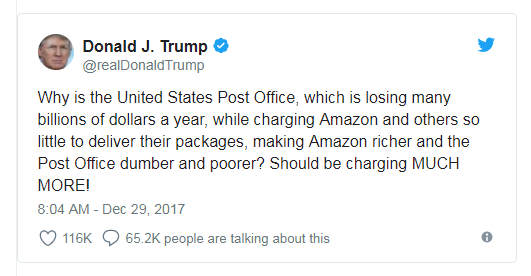
President Trump was off base Friday when he implied that Amazon has a sweetheart deal with the U.S. Postal Service.

But for reasons unrelated to Trump's' charges, it may be time for the USPS to rethink the prices it charges Amazon and perhaps for all package deliveries. In fact, there’s evidence the Postal Service is already doing that.

While containing no outright falsehoods, Trump’s tweet is a mix of truth and debatable claims.

Let’s take apart his claims:

• The USPS is “losing many billions of dollars a year”: Officially, that’s true, but only because the Postal Service is indirectly subsidizing the federal government via prepaid retiree health benefits and by paying more than its share of combined federal/USPS pension costs. Absent those accounting gimmicks, the Postal Service has operated at about breakeven the past few years.

• The USPS “is charging Amazon and others so little to deliver their packages”: True, but it's a non-issue. The USPS is generally able to charges the lowest rates for residential parcel deliveries it's the low-cost provider.

• “Making Amazon richer”: The Postal Service’s moves to gain a larger share of the residential package market have definitely benefited Amazon – and plenty of others who ship packages. Competition tends to do that. It's called capitalism.

• The Amazon deal is making the USPS “dumber.” Not likely. The USPS can learn from Amazon’s sophisticated approach to logistics.

• The Amazon deal is making the USPS “poorer.” Not according to the Postal Regulatory Commission, which vets package-delivery rates, including those negotiated privately by the likes of Amazon, to ensure they are profitable for the Postal Service.

Trump isn’t the first to question the low postage rates Amazon pays. Various commentators, special-interest groups, and others have raised the issue from time to time.

Challenges to the Amazon deal fall into three categories: the “sweetheart deal” argument, the “unfair competition” argument, and our own Dead Tree Edition observations.

The “sweetheart deal” argument
Those who claim Amazon negotiated too sweet a deal with the Postal Service naively point to estimates that its postage rates are well below those paid by mom-and-pop shippers. A Wall Street Journal op-ed written by the head of “a money-management firm that owns FedEx common stock” (Hmm, any bias there?) typifies the muddled thinking:

“The U.S. Postal Service delivers the company’s boxes well below its own costs,” wrote Josh Sandbulte, who estimated that the USPS handles about two-thirds of Amazon’s U.S. deliveries. “Select high-volume shippers are able to drop off presorted packages at the local Postal Service depot for “last mile” delivery at cut-rate prices. With high volumes and warehouses near the local depots, Amazon enjoys low rates unavailable to its competitors.”

In other words, Amazon goes to great expense to minimize the USPS’s costs of delivering Amazon packages; in return, Amazon pays lower postage rates. Such “worksharing” discounts are a standard, and quite logical, part of most postage rates: The more you do to reduce the Postal Service’s costs – via sorting, dropshipping, efficient packaging, etc. – the lower your postage bill.

Amazon presented the chart below to the PRC early this year in defense of its low rates, saying it “has established a transportation and distribution network of more than 25 sort centers and more than 70 fulfillment center warehouses. This network enables Amazon to inject parcels at Postal Service Destination Delivery Units (“DDUs”) already presorted for delivery to the customer.”


“This arrangement," Amazon says, benefits the Postal Service by letting it make more efficient use of its delivery facilities, equipment and personnel while avoiding the costs of building additional capacity in the Postal Service’s upstream network.”

The “unfair competition” argument

FedEx itself, along with fellow USPS competitor United Parcel Service, has a more sophisticated argument – that parcel shippers aren’t paying their fair share of the Postal Service’s costs.

Imagine that a letter carrier delivers four pieces of mail and one Amazon package to a particular address. The “fair-share” camp says that at least 20% of the labor, fuel, and other costs required to make that delivery should be assigned to the package.

But the USPS only looks at the incremental costs of delivering packages and other “competitive” products. For example, the labor and fuel required to drive to the mailbox are not factored into the cost of (or price for) delivering the package because those costs would exist even if the carrier were only delivering the letters.

The result, say USPS’s competitors, is that the Postal Service undercharges package shippers while overcharging those who send letters and other traditional mail. But the PRC sides with the USPS.

Dead Tree Edition's observations
The USPS-PRC approach to pricing isn’t just consistent with the law, it's good business practice.When evaluating a product, the question is whether the organization would be more profitable without the product than with it. That means ignoring any costs that would remain if the product were discontinued.

But the USPS-PRC approach has a couple of shortcomings.

Because its tiny 30-year-old delivery vehicles were designed primarily with letters in mind, the Postal Service is increasingly relying on parcels-only delivery routes to cope with the e-commerce boom. That’s driving up the average cost of delivering a parcel.

But setting postal rates is a bit like driving while looking in a rear-view mirror: Projections are based on elaborate analyses of historical data – in this case of a time when most parcel deliveries could easily be piggybacked onto regular mail routes. It’s also unlikely that the Postal Service’s current cost models fully reflect the increasing amount of real estate devoted to sorting and handling parcels.

And it’s well-nigh impossible for those models to factor in opportunity costs.

The USPS’s deals with Amazon have been based on the premise that most of the additional deliveries would be done by city carrier assistants (CCAs), whose compensation is less than half that of career letter carriers. The labor contract with the National Association of Letter Carriers caps the number of CCAs the USPS can hire, while allowing additional ones to be brought on for non-traditional ventures like the Amazon deals.

But, contrary to its expectations, the Postal Service has struggled to hire, train, and retain the full complement of CCAs. The parcel boom has also meant plenty of work – and overtime -- for CCAs and career carriers alike.

Under these conditions, the Amazon deal is sucking up a limited resource: inexpensive (about $17/hour) CCA labor. That deprives the Postal Service of the cost-reducing opportunity to use more straight-time CCA hours on non-Amazon deliveries.

Here’s a hint that the Postal Service may be wising up to such hidden costs: A small experimental venture that had CCAs delivering groceries for Amazon Fresh apparently collapsed recently. One reason, Recode reports, is that “Amazon balked at new delivery rates USPS was going to charge the company.”
"The bottom line is whether the USPS would be better off without Amazon than with it."
Still, Amazon pays the U.S. Postal Service billions of dollars annually – probably well over 10% of the agency’s total revenue. The bottom-line question is whether the Postal Service would be better off without the current Amazon deal than with it. The answer is neither the clear "no" that Trump and other critics would have us believe, nor the clear "yes" indicated by the PRC’s rulings.

In fact, I doubt anyone can provide a definitive answer.

Related Dead Tree Edition articles include:


Monday, April 20, 2015

Why Letter Carriers Are Not an Endangered Species

“Mail carrier” was recently named as one of the 10 worst careers in the U.S., largely because of a supposedly bleak employment outlook.

“Hiring of mail carriers has been on a steady decline with the proliferation of email and text messaging,” CareerCast said in ranking mail carrier #191 out of 200 careers. “Of all careers tracked in the 2015 Jobs Rated Report, mail carrier has the worst 10-year growth outlook.”

CareerCast’s jobs outlook was based on a U.S. Labor Department projection that the number of mail carriers would shrink by 28% from 2012 to 2022. That’s no surprise: Just about everyone knows that digital technology is making letter carriers an endangered species.

There’s just one problem with this scenario: “Just about everyone” is wrong.

The number of people delivering mail for the U.S. Postal Service is actually growing slightly.

It's true that since the end of 2012, the number of career USPS employees involved in mail delivery has dipped slightly, from 243,000 to 237,000. But the shrinkage all occurred during 2013; recent statistics show the number has stabilized or is rising slightly.

And when non-career employees like city carrier assistants (CCAs), are included, mail delivery looks like a growth field. That, plus the high turnover among CCAs, is why “We’re hiring!” signs are popping up at many post offices.

USPS statistics don’t provide apples-to-apples comparisons of non-career employee counts, but the numbers on hours worked are a good proxy. So far this year, the straight-time hours worked by all (both career and non-career) “city delivery carriers” are up 5% from two years ago, while the hours for all “rural carriers” have increased nearly 3%.

Digital technology taketh away, and . . . 
What “just about everyone,” including the Labor Department, seems to miss is that digital technology – specifically, online purchasing – is adding work for the Postal Service’s carrier force. When stuff is bought online, someone has to deliver it.

And when that delivery is to a residential address, chances are that the “final mile” is handled by a USPS letter carrier even if the package was sent via UPS or FedEx.

The Postal Service is doubling down on its unique ability to reach every residential address. It has slashed some Priority Mail prices for frequent shippers and is testing rapid delivery of everything from fresh flowers to groceries.

Outgoing Postmaster General Pat Donahoe hinted late last year that Sunday delivery of packages would soon become the norm, not just something USPS does for Amazon in select markets.

So all indications are that the number of packages delivered by letter carriers will continue growing, which is why specs for USPS’s new delivery vehicles call for more storage space. Those packages are far more labor intensive than traditional mail; Priority Mail boxes don’t end up in nice walk-sequenced trays or carrier-route bundles.

And even the labor savings from the gradual shrinkage of traditional mail mostly get canceled out by continuing growth in the number of delivery addresses.

The big threat
The big threat to employment levels for USPS carriers is possible curtailment of Saturday delivery of letters and flats. But that would put only a sizable dent – nowhere close to a 28% reduction – in letter-carrier employment levels.

And it continues to face rough going in a reluctant Congress, where members have recently been getting an earful from constituents about slow delivery.

So don’t put letter carriers on the endangered-species list just yet. (There may be good reasons to put “mail carrier” on the list of 10 worst jobs, as I'm sure some postal workers would be happy to explain, but employment prospects are not one of them.)

The moral of the story: Beware of projecting past trends into the future, especially when the recent past runs counter to those projections.

Related articles:

Saturday, November 1, 2014

Donahoe Signals Change of Heart on Weekend Deliveries

Postmaster General Patrick Donahoe made a statement this week demonstrating that postal executives’ views about weekend delivery of packages have changed significantly in the past four years.

"The future will be a seven-day package world and a five-day mail world," a USA Today article quoted Donahoe as saying.

In 2010, the U.S. Postal Service released its “action plan for the future” that called for elimination of Saturday delivery, with no exceptions. But, responding to concerns about delayed deliveries of prescriptions and other vital parcels, postal officials acquiesced and changed their plan to include Saturday delivery of packages.

No one – not even the most ardent advocates of postal service or even the postal unions – was talking about adding Sunday delivery of any kind.

But in recent months, weekend delivery of parcels has gone from obligation to opportunity. The Postal Service is delivering Amazon packages in a growing number of urban markets. In San Francisco, it is testing same-day, seven-days-a-week delivery for multiple retailers and today added early-morning grocery deliveries to its test offerings in that city.

Donahoe’s comment to the newspaper suggests that the long-term plan is for Sunday to become just another day of delivery as far as parcels are concerned.

Why the change of heart?
Why are postal executives who wanted to eliminate a day of parcel delivery barely four years ago now trying to add a day?

They are seeing huge potential in the e-commerce boom, which is fueling rapid growth in business-to-residence deliveries. And they are recognizing where the much-maligned USPS has competitive advantages over its private competitors.

United Parcel Service, for example, is seeing 60+% annual growth in UPS SurePost, its low-priced option that turns packages over to the Postal Service for final delivery. FedEx’s SmartPost similarly relies on the Postal Service to for “the last mile” delivery to residential customers. Neither company can deliver to residential customers as efficiently as USPS can.

In a move to cut out those middlemen and grab more of the e-commerce dollars, the Postal Service recently reduced Priority Mail parcel rates for big mailers by as much as 55%.

Changes in its workforce have also enabled USPS to reduce its delivery costs. The average hourly rate for the city-carrier force, for example, dropped 5% in the past year as the Postal Service increasingly relied on city carrier assistants (CCAs) and other non-career employees. The agency plans to have only CCAs delivering groceries in the San Francisco test.

What’s also changing is the Postal Service’s strategic focus. The same electronic media that are cutting into USPS’s traditional bread and butter – delivering letters – are also creating profitable growth opportunities in the package business. That’s why it wants to give short shrift to traditional mail while expanding service in the package realm.

Unlike letter delivery, USPS doesn’t have a monopoly in the parcel world. But its massive delivery network and unique ability to reach every address in the country every day of the week may give it a virtual monopoly in certain types of package delivery.

Related articles:


Saturday, October 11, 2014

Third Bush on the Right, Please: USPS Grocery Deliveries Would Need Lots of TLC from Carriers

Mail carrier was recently named the most endangered job in the U.S., but the U.S. Postal Service seems to have other ideas. Its plan to deliver groceries to households in major metropolitan areas is the latest among several strategic moves that would mean more work for employees who handle the "last mile" of delivery.

Please, Mr. Postman, look and see,
Are there some groceries in a tote for me?

The Postal Service’s proposed market test of same-day grocery deliveries, apparently in partnership with Amazon, would require even more TLC on the part of USPS’s carrier force than normal deliveries, the agency revealed this week in filings with the Postal Regulatory Commission.

“All Customized Delivery items will be transported directly to a customer’s door and will be delivered [between 3 a.m. and 7 a.m.] without disturbing the recipient,” USPS revealed to the PRC. “Customized Delivery also will allow recipients to provide specific delivery instructions.”

Back door man
“Carriers would need to go to each delivery door and manage customer specific delivery instructions.” To avoid theft of the early-morning deliveries, such “special delivery instructions” could conceivably include placing the special grocery-filled totes at back doors, in hallways, into parked cars, or even behind bushes. Undeliverable totes would be returned to the shipper.

“Participants will pay a fee for the Customized Delivery Service,” USPS wrote. UPS is reportedly close to rolling out a service that, for a $5 fee or a $40 annual membership, would deliver someone’s packages to a nearby store instead of to the home.

The Postal Service has recently been encouraged to enter a wide variety of new ventures, most notably providing banking services to the poor and to rural residents. But postal executives’ new-revenue plans are all focused on leveraging the agency’s massive, every-address delivery network: not only by serving the grocery business but also with Sunday deliveries for Amazon, aggressive price cuts on lightweight packages sent by large mailers, and seeking legislative approval to deliver wine and beer.

All of those growth efforts are far more labor intensive – and higher priced – than USPS’s traditional job of delivering letters. The Postal Service is also adding thousands of new delivery points every day, requiring more travel time for carriers even if mail volumes don't grow. So it's premature to assume that letter carriers will soon go the way of buggy-whip makers.

Market disruption? 
To gain the PRC’s approval for its proposed two-year “Customized Delivery” market test of grocery delivery, USPS must show that the venture would not disrupt existing markets or rely on “unfair” competitive advantages over private businesses.

Starting later this month, USPS wants “to test and develop a long-term, scalable solution to enable expansion of customized delivery to additional major metropolitan markets across the nation.” It might also test other delivery times during the day.

“The Postal Service will negotiate price with each customer [presumably the grocer, not the consumer], in part, based on the pickup schedules specific to each customer.” USPS also hopes the test will determine “the optimal pricing structure for this type of service.”

San Francisco test  
The agency recently conducted a smaller-scale test of grocery delivery in the San Francisco area. City carrier assistants – non-career postal employees – delivered about 160 totes per day to 38 ZIP codes, according to postal officials.

“In the current process,” USPS told the PRC, “the retailer brings groceries already packed into retailer-branded totes, some of which are chilled or include freezer packs, directly into Postal Service destination delivery units (DDUs) between 1:30 a.m. and 2:30 a.m."

“The totes are all the same size and color, and have a QR code on the outside. The Postal Service receives a manifest file from the retailer containing the address and QR code number for each tote. This file is used by the Postal Service to dynamically route totes and create a line of travel for each route.”

“These deliveries are unattended — the CCA will not ring the doorbell or knock on the door. The carrier places the totes in a location designated by the consumer for delivery.

“Totes are scanned [sometimes with an iPhone] at key steps in the process to provide tracking and visibility through to delivery. CCAs wear postal uniforms and lighted caps as a safety measure and for easy recognition by the public.”

[Editor’s note: Perhaps such lighted caps should also be provided to carriers who have to make normal deliveries after sunset during the winter months.]

Related articles:

Saturday, September 13, 2014

Rate Cut Has Shippers Switching To USPS

The Postal Service’s recent price cuts for big businesses that ship packages are already trickling down to the small fry, like eBay seller Joe Strader. And based on Strader’s reaction to the rates that took effect on Sunday (Sept. 7), a lot of other small shippers will be switching their business to the U.S. Postal Service as well.

The proprietor of the eBay store Joe’s Surplus and Salvage noted a change he made this week on an item he ships frequently.

“In the past this would have been all FedEx but Priority Mail beats them with the discount. In addition, it gets there on Saturday rather than Monday. For small items, I get free boxes, not an insignificant saving.”

"Yes, that is a 49% discount off of retail,” Strader says of the USPS shipping quote of $9.14 for sending a 20-pound package.FedEx would have charged $10.86 for the same shipment, and United Parcel Service would have been even higher, he adds. Before the rate change, Strader used the Postal Service almost solely for items weighing less than 6 pounds.

“This is going to get ugly,” he says of the heightened parcel competition among the Postal Service, FedEx, and UPS. The new Priority Mail rates are slightly higher for retail customers who drop off a package at a post office but up to 55% lower for medium-weight packages sent by large business mailers.

Extra bonus for eBay merchants 
EBay sellers have an additional reason to like the new Priority Mail discounts: “When a customer of eBay calculates shipping, it gives the rate before the discount. The seller gets the difference,” explains Strader, who offers most of his eBay merchandise with free shipping. “For those that charge shipping on transactions based on calculated rather than flat rate, it is a significant difference” (and additional profit).

He even finds the much-maligned Postal Service often beating its private-sector competitors on customer service. He described what happened with a recent USPS shipment that was supposed to be next-day service but took two days:

“I filled out the simple form, took my receipt and paperwork to the post office and handed it over. After a few strokes on the computer, I had a cash refund, that day, no waiting. I was shocked that I did not have to wait a few weeks like FedEx or UPS only to find out it was my fault for some reason. I asked and the agent said that since it was delivered and obviously the wrong date, the refund is automatically processed.”

“Admittedly, mine is a small town post office and much more convenient than most. However, the service is great, they have picked up as many as a dozen small packages at my door (UPS and FedEx Ground charge by the package), and a lot of stuff I just put in the mailbox with the flag up. They have a few goofy employees, they are often slow at the window, and there are occasional lines (don't go at 8:30 or 3:30). But, I ship 90% of my items USPS.”

Related articles:

Thursday, July 31, 2014

Frenemies: The Love-Hate Relationship Between UPS and the Postal Service Blossoms

The rise of online purchasing is boosting the partnership between United Parcel Service and the U.S. Postal Service – and fueling their rivalry as well.

Volume for UPS SurePost – lightweight parcels that are typically handed over to the Postal Service for final delivery to residential addresses – were up more than 60% in the past year, UPS announced this week.

UPS also revealed a coup of sorts: “During the quarter, a retail customer upgraded its catalog distribution to UPS Ground from the U.S. mail, contributing to our ground growth,” CFO Kurt Koehn said during the company’s quarterly earnings call. He didn’t name names, but only a large customer could cause meaningful growth in the company’s $6.2 billion quarterly revenue for domestic ground shipments. (Update: Several readers pointed out that the customer was Restoration Hardware, which recently shipped 17-pound multi-catalog bundles via UPS.)

The big shipping company is also wary of the Postal Service trying to steal market share with its recent proposal to slash prices on some commercial parcel shipments. (See FedEx Cries Foul Over Postal Service Price Cuts for more on why USPS's competitors are trying to block the proposal.)

Sharing customers
“We work very closely with the post office,” said D. Scott Davis, UPS’s CEO. “We appreciate their universal service mandate where customers of theirs are customers of ours, but there is some concern as we go forward and how they price competitive products and there is some concern about cross-subsidization.”

Both UPS and FedEx contend the Postal Service has shifted too much of its cost burden to “market-dominant” mail classes like First Class and Standard, which enables it to keep package prices artificially low. The company, Davis said, will continue fighting that battle at the Postal Regulatory Commission, which will rule soon on USPS’s proposal to reduce many parcel rates by 30% and some by 55%.

“At the same time, we’ll go out and compete with the post office,” he added.

But the Post Office is also being urged to be more competitive with UPS.

“The Postal Service’s mix of packages generated a relatively low revenue per piece of $3.37,” the independent USPS Office of Inspector General wrote in a recent study. UPS and FedEx each earn more than $9 per package.

“While the Postal Service has long served low revenue market segments such as lightweight packages very well, customer demand has created opportunities to offer value-added services and enter the higher revenue per piece segments,” the report said.

“The Postal Service cannot afford to be the provider of last-mile delivery only when the revenue is low and the cost is high. Such ‘cream skimming’ will harm the Postal Service’s package revenue and its ability to fund universal service.”

Saturday, July 19, 2014

FedEx Cries Foul Over Postal Service Price Cuts

Poor FedEx.

The market for delivering items purchased on the Web is growing, but the U.S. Postal Service isn’t playing fair, FedEx complained this week. The big delivery company is trying to stop USPS from cutting prices to deliver certain types of packages.

For the record, FedEx stock is worth north of $43 billion. USPS is consistently unprofitable and basically insolvent.

“What USPS is proposing is an aggressive push to gain market share in the fast-growing business of e-commerce distribution services,” FedEx told the Postal Regulatory Commission. “To this end, USPS is proposing reductions of 30 to 55 percent in prices for commercial shippers in the weight categories most used by e-commerce. Price reductions of such magnitude will substantially affect competing service providers and the market as a whole.”

Consumers would pay more, businesses less
The Postal Service wants to restructure Priority Mail rates. Prices would increase for retail customers – individuals who drop off packages at a post office counter – by an average of 1.7%. But some prices for commercial shipments would decrease, a Postal Service attempt to attract more ground shipments weighing 6 to 20 pounds.

Postal regulations are supposed to ensure “that USPS does not derive an unfair advantage from legal or governmental privileges when it competes with private sector companies,” FedEx wrote.

It asked the PRC to make sure “that prices for USPS’s package services correctly reflect costs, so that the ‘playing field’ for e-commerce distribution services remains as a level as possible.”

$2 billion in profit vs. a $5 billion loss
“Packages delivered by USPS benefit from an exclusive right of access to mailboxes and clusterboxes, a postal operator privilege that does not exist anywhere else in the world,” FedEx wrote. The postal monopoly also gives USPS “economies of scope” that bear some of the costs of package delivery.

Translation: Because USPS has to deliver to every home six days a week, it can deliver a package to that home cheaper than FedEx, which only delivers to that home when it receives enough profit to do so. Maybe that’s why FedEx earned more than $2 billion in profit last year while USPS lost nearly $5 billion.

Like UPS, FedEx complained that secrecy surrounding USPS’s “Competitive Products” makes it impossible to prove that USPS’s proposal is contrary to law.

“One-time price cuts of as much as 55% raise serious questions that the mailers in the mid-weight categories are getting subsidized by someone – what FedEx cannot tell the Commission for sure is, by whom,” FedEx wrote. “Largely left behind in this price-cutting frenzy is the ordinary retail customer who brings his package to the local counter.”

UPS and FedEx also agree that USPS’s Competitive Products should bear more than 5.5% of the agency’s institutional costs now that they represent nearly one-fifth of the agency’s revenue.

Related articles:

Monday, December 2, 2013

UPS Praises Postal Service's Improvements, But Not Its Rate Hikes

United Parcel Service recently praised “impressive efforts by the Postal Service to reduce costs and improve productivity” but criticized USPS's request for emergency rate hikes.

The Postal Service’s request for “exigent” rate increases on “Market-Dominant” mail is “an unsustainable business model which can only lead to continued postal deficits and more requests to exceed the rate cap,” UPS wrote in a filing last week with the Postal Regulatory Commission. Instead, USPS’s “Competitive” products should bear a larger share of the agency’s institutional costs, according to UPS, which is a major competitor, customer, and vendor of the Postal Service.

Market-Dominant mail includes such classes as First-Class, Standard, and Periodicals, where USPS’s mailbox monopoly is a huge barrier to competition. Rate increases for such mail can generally be no greater than the rate of inflation, except USPS is seeking higher rates starting in January to compensate for revenue it lost as a result of the recent recession.

By contrast, “Competitive” services include expedited and parcel delivery, where USPS tends to compete head on with UPS, FedEx, and other private businesses. For such mail, USPS can charge what the market will bear. But much of the category’s profit gets tied up in a Competitive Products Fund that the Postal Service cannot easily access.

In the past six years, “Competitive Product revenues have grown by more than 40%, while Postal Service mail and services revenues as a whole have fallen by about 13%.”

Nevertheless, Competitive Products have continued to pay only 5.5% of USPS’s institutional costs, while the unprofitable Market-Dominant category covers the rest.

“Competitive Products’ share of total Postal Service revenue has risen from approximately 11% in FY2008 to over 18% in FY2012,” UPS wrote. “This trend is likely to continue, with Competitive Products expected to account for more than 20% of total postal revenue in FY2013 and over 23% in FY2014.”

Yet the Postal Service’s pricing strategy runs counter to the customary tactic of hiking prices based on rising demand.

“The Postal Service proposes a Market-Dominant average rate increase of more than 5.9%, while it proposes a Competitive Products average rate increase of only 2.4%, with no rate increase for Priority Mail overall,” UPS notes.

Breaching the inflation-based price cap on Market-Dominant mail will “accelerate” the ongoing decline in such mail, UPS claims.

“In short, it is unsustainable for the Postal Service to continue to rely on shrinking Market-Dominant volumes to pay the vast majority of institutional costs. The Commission should require growing Competitive Product revenues to contribute a more equitable share.”

The UPS filing doesn’t spell out the company’s motives. Its proposal would tend to cause larger price increases for the Postal Service’s Competitive Products, which go head to head with UPS’s own offerings and are gaining market share. But because it often outsources the “last mile” of delivery to the Postal Service’s vast carrier network, UPS also has a genuine interest in the health of Market-Dominant mail.

UPS’s filing doesn’t seem to be the work of a company that, as some conspiracy theorists claim, secretly wants to take over the Postal Service. Instead, its actions are consistent with its 2009 statement that, "We believe that the government plays a role in terms of ensuring that every mailbox is reached every day. That is not a responsibility that UPS would want.”

Related articles:

Saturday, November 26, 2011

On USPS Privatization, George Will Strikes Out

George Will is a Pulitzer Prize-winning political commentator who has penned some of the most beautiful prose ever written about baseball. But yesterday, in opining about the U.S. Postal Service, he whiffed when it came to basic fact checking.

After a fascinating history lesson about how Sunday mail delivery was discontinued a century ago, Will threw this clunker into his commentary for the The Washington Post:

"Surely the government could cede this function to the private sector, which probably could have a satisfactory substitute system functioning quicker than you can say 'FedEx,' 'UPS' and 'Wal-Mart.' The first two are good at delivering things; the third, supplemented by other ubiquitous retailers, could house post offices."

Question for Mr. Will: When was the last time you sent or received anything via FedEx or UPS that cost only 34 cents? Or even anywhere close to 34 cents? The average price USPS charged last fiscal year for First Class and other monopoly classes of mail was 34.1 cents.

More questions: When was the last time FedEx or UPS begged for the chance to take over the Postal Service's business? When was the last time you heard an executive from one of those companies say, "Gee, we'd really like to deliver mail to every address in the country, regardless of profitability and without price discrimination; we can't wait to drive snowmobiles in Alaska and to take mule trains into the Grand Canyon so that we can complete our appointed rounds"?

Yes, FedEx and UPS are "good at delivering things." So are moving companies and obstetricians. But none are set up to do what the Postal Service does on the scale that the Postal Service does it.

Both FedEx and UPS are happy to serve businesses five days a week (or to charge premiums for weekend delivery). But going to private homes is another matter. Their favorite method of getting low-value shipments to residences is to pay the Postal Service for making the actual deliveries.

Perhaps privatization of some or all U.S. postal services makes can or should lie in the future. But it won't simply be a matter of turning over mail delivery to the private sector, especially when no one in the private sector seems to be clamoring to take over the U.S. Postal Service and all the requirements and restrictions imposed on it.

Sunday, May 2, 2010

Postal Service Scores a Win with Walmart

If FedEx and UPS are so much more efficient than the U.S. Postal Service, how did the USPS manage to beat its private rivals for an exclusive deal with the nation’s toughest customer?

At last month's National Postal Forum, postal officials were bragging that they had recently negotiated an agreement with Wal-Mart to be its exclusive shipper of prescriptions ordered by telephone. The drugs will be sent via Priority Mail, with Wal-Mart picking up the tab, according to Clint Bolte’s excellent summary of the forum at PrintCeo.

“Wal-Mart has a reputation throughout its history of driving down each of their suppliers’ prices. Wal-Mart surely put FedEx, UPS, and USPS up against one another to obtain the cheapest distribution price possible,” Bolte wrote. “USPS CFO Joe Corbett remarked that he sits on the seven-person pricing committee and is personally confident that this Wal-Mart contract will be profitable to the Post Office.”

That might surprise the misguided pundits and politicians who pontificate about how the Postal Service should privatize or outsource delivery. But when it comes to delivering small items inexpensively to homes, it’s pretty clear that FedEx and UPS can’t compete with the Postal Service.

Often, they don’t even try. Both have outsourced much of their final delivery to the Postal Service. FedEx favors the Postal Service especially for lightweight packages delivered to residences, according to industry analyst Alan Robinson.

The reason is obvious: The Postal Service is going to deliver to a residence any way, so adding one more small package to the delivery won’t cost much. To make the same delivery itself, FedEx would usually have to add another stop to a driver’s route. And of course FedEx must deliver to the doorstep, not to the mailbox.

FedEx and UPS thrive by making high-value deliveries (for example, those involving big packages, overnight service, or delivery confirmation) especially to business locations that receive multiple items each day. But for a packet or bottle of pills destined for a residence, where the service level of Priority Mail is good enough, the Postal Service is clearly in the driver’s seat despite its inefficiencies and enormous fixed costs.

I wonder how many other retailers could lower their inventory costs by using the Postal Service.